
• Link to Facebook
  • Link to Instagram
  • Link to Youtube
  • Home
  • Tours
  • About
  • Contact
UtahGeology
  • Guided Tours
  • Hiking Guides
    • Geologic Hiking Guides
  • Geoarchaeology
    • Archaeology Explorer
    • Were the Ice Ages Caused by True Polar Wandering?
  • Geologic History
    • Utah Geologic History
    • Geologic History Overview
    • Geologic History of Utah & the Colorado Plateau
  • Road Guides
    • Utah Geologic Road Guides
    • Road Guides Overview
  • Geologic Formations
    • Geologic Formations
    • Geologic Formations Overview
  • Stratigraphic Columns
    • Utah Stratigraphic Columns
    • Stratigraphic Columns Overview
    • Layer Thickness Map
  • More
    • About
    • Contact
    • Geo Imagery
    • Earthquake Viewer
    • Interactive Map Gallery
    • Whats New?
    • Image & Copyright Policy
    • Web Links
  • Click to open the search input field Click to open the search input field Search
  • Menu Menu
You are here: Home1 / summerville

Tag Archive for: summerville

Summerville Formation (Geology of Utah’s Grand Staircase)
April 24, 2025/in Geologic Formation Pages/by Lance Weaver
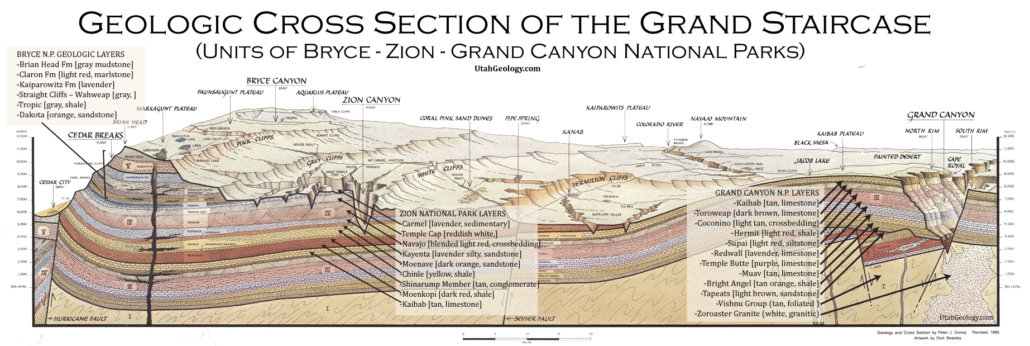
Geologic Cross section of the layers of The Grand Staircase from Bryce through Zion to the Grand Canyon National Parks.

Explore unit thickness in All-in-One App

Exposure:

Within the Grand Staircase, the Summerville Formation is best exposed in east of Capital Reef National Park just south of Goblin Valley State Park.

Age:  Deposited Middle Jurassic, early to late Oxfordian time (161 – 155 Ma) (Wilcox, 2007).

Depositional Environment:

Marginal marine and sabkha/tidal. One unconformably-bound, transgressive-regressive (T-R) sequence, marine (saline lacustrine?) and marginal-marine (Wilcox, 2007).

Paleogeography:

A major transgression of the Late Jurassic seaway drowned the eolian sand sea of the Entrada Sandstone.  Subsequent regressive paleoflow was to the northeast into the Late Jurassic interior seaway (Kocurek & Dott, 1983, Blakey 2008).

Tectonics:

Deposition was in a retroarc to craton-margin basin as the region drifted north (Kocurek & Dott, 1983). 

Climate:

Hot & Arid. Kocurek & Dott, 1983 suggest paleolatitude range of 5 to 25 degrees north. I disagree and suggest 25-40 degrees north within a stark rain shadow of the ancient Navadaplano, similar to current Mapmi basin in Mexico.

Features:

The Summerville is noted for its thin red beds of rippled sandstones and mud cracks, overprinted with secondary gypsum veins. The Jurassic “J3” unconformity, a regional surface of erosion atop the Entrada Sandstone, marks the basal bounding surface of the Curtis-Summerville T-R sequence.  A thin, lower Curtis transgressive systems tract is the finest grained facies of the Curtis Formation topped by a maximum flooding surface.  Thick middle and upper Curtis represents a highstand systems tract reflected in upward coarsening cycles from marine shelf to tidal channels to shoreface.  The upper sequence is tidal flat, reddish-brown mudstones and evaporites of the Summerville Fm topped by the “J5” unconformity, the upper sequence bounding surface and the contact with overlying Morrison Formation (Wilcox, 2007).
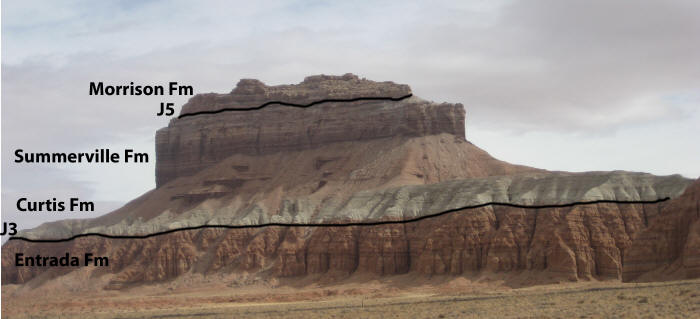
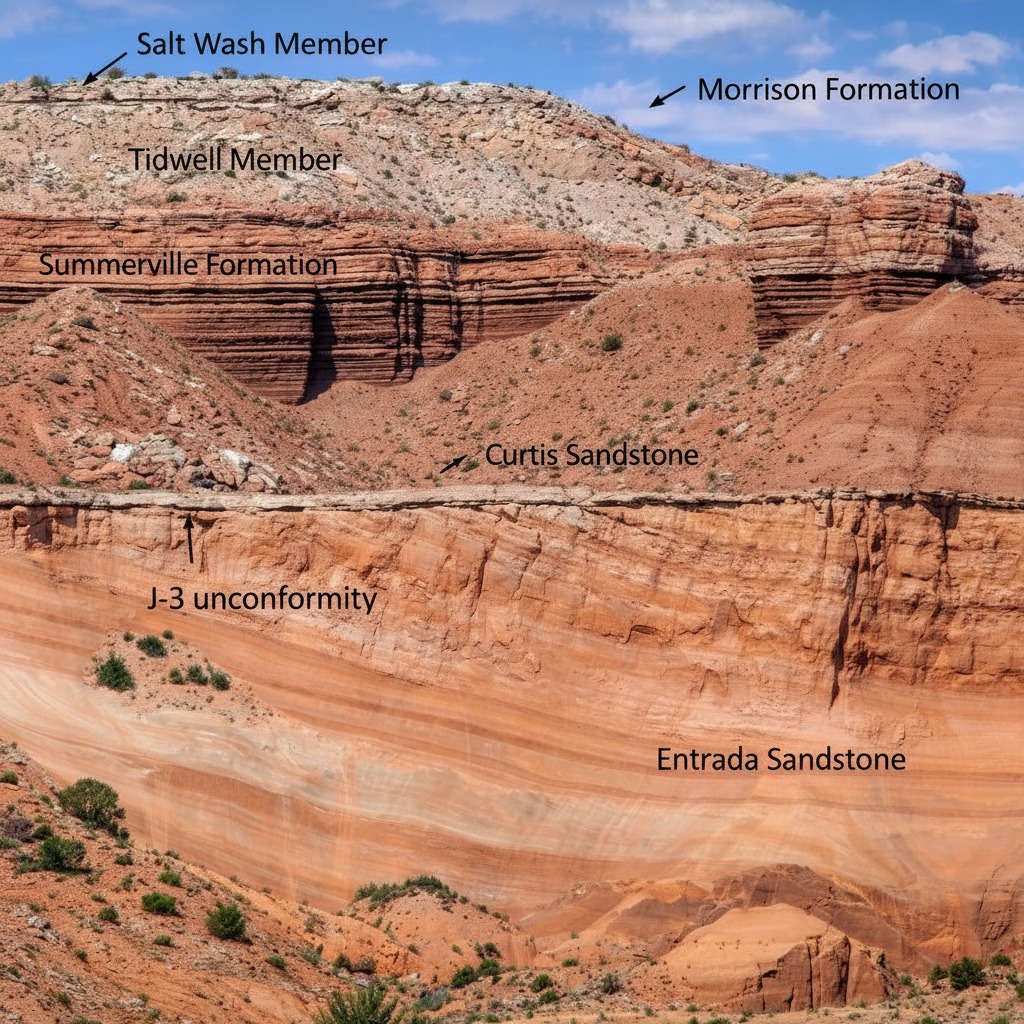
View of the Morrison Formation, the Summerville Formation, the Curtis Formation, and the Entrada Formation.

Description:

The Summerville formation consists of up to 100 meters (330 ft) of red mudstone, with thin interbeds of green and red sandstone. The lower portion of the formation shows polygonal desiccation cracks and localized salt-hopper casts while the upper portion contains considerable gypsum, consistent with deposition in a sabkha on the margin of the Sundance Sea.It is exposed in the San Rafael Reef, the Waterpocket Fold, in the Henry Mountains, with additional exposures scattered across the region from the San Rafael Reef to the Paradox Basin, and in north-central New Mexico. The thin bedding is characteristic throughout the formation, but gypsum is not found in the San Juan Basin and some conglomerate is found on the south and southwestern margins of the formation. The correlation of late Jurassic beds in northwestern New Mexico with the Summerville Formation in Utah has been questioned, and it has been suggested that they be assigned to the Beclabito Formation instead.

The Summerville Formation rests conformably on the underlying Curtis Formation (Utah and western Colorado) or Todilto Formation (southwest Colorado and New Mexico) but is separated from the overlying Morrison Formation by the regional J5 unconformity.[1] It thins significantly in the Moab-La Sal area, the likely area of the divide between the marine Curtis basin to the northwest and the salina lake Todilto basin to the southeast. Here the formation is just 1.2 meters (3.9 feet) thick and rests directly on Entrada Sandstone. In many locations the Summerville is separated from the Morrison by eolian sandstones, such as the Bluff Sandstone, variously assigned to the Morrison Formation or the San Rafael Group. The Morrison Formation represents a return to more humid conditions with increased clastic input.

Modern Analog to Utah’s Middle Jurassic
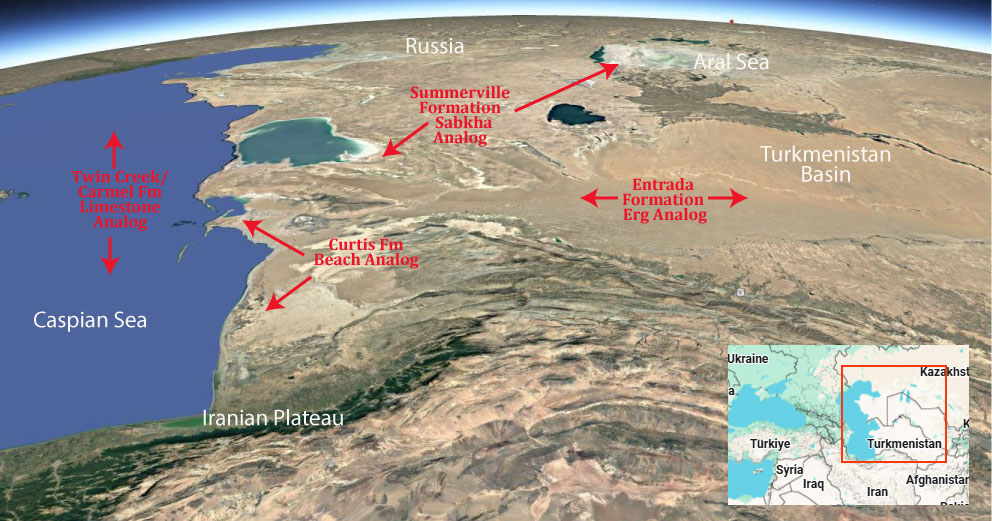
Many modern analogs have been proposed for the desert ergs, sabkha’s and limestone’s of Utah’s Middle Jurassic, but we favor Africa & the Turkmenistan/Caspian Basin as it includes all the depositional environments found for this geologic period.

.

Paleogeography or Depiction of Utah during Middle Jurassic
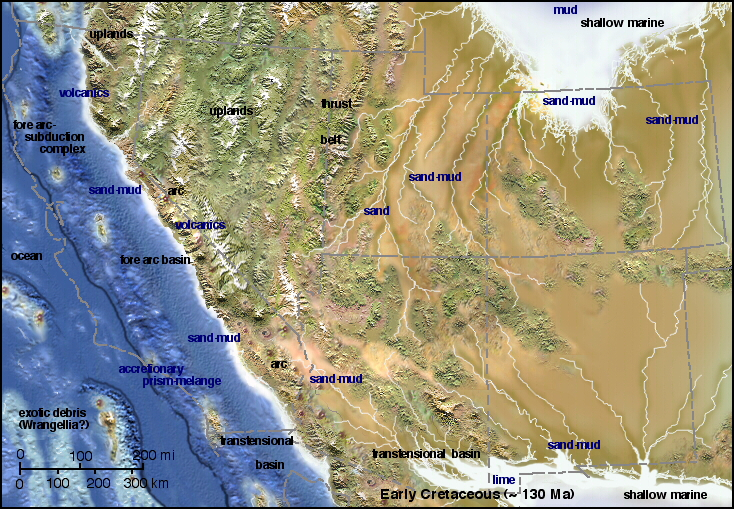
Figure 1: Paleogeographic map of the Middle Jurassic, Page Sandstone, Carmel Formation, Entrada Sandstone, Curtis Formation, and Summerville Formation. (Blakey, 2008)

What is the Grand Staircase?

The Grand Staircase is a unique and extensive exposure of Earth’s history, showcasing over 200 million years of sedimentary rock layers. Geologists often liken these layers to a “book,” allowing for a detailed study of the Earth’s past, including changes in climate and environment.

The major sedimentary rock units exposed in the Grand Canyon range in age from 200 million to 600 million years and were deposited in warm shallow seas and near-shore environments. The nearly 40 identified rock layers of Grand Canyon form one of the most studied geologic columns in the world.

[flickr_tags user_id=”95435349@N04″ randomize=”true” margins=”4″ pagination=”numbers” tags=”navajo” max_num_photos=”9″]

[flickr_tags user_id=”95435349@N04″ tags=”chinle, navajo”]

https://utahgeology.com/wp-content/uploads/2025/07/utah-geology-site-logo-420px-new.png 0 0 Lance Weaver https://utahgeology.com/wp-content/uploads/2025/07/utah-geology-site-logo-420px-new.png Lance Weaver2025-04-24 17:25:252026-04-26 17:26:10Summerville Formation (Geology of Utah’s Grand Staircase)

Welcome

About me
Lance Weaver. about me.


Book a Tour

Popular
  • Tracks, Traces & Other Fossils of The Grand Canyon &...January 7, 2025 -
  • When Was The Colorado River Formed?February 21, 2025 -
  • Were the Ice Ages Caused by True Polar Wandering?September 21, 2020 -
  • Navajo SandstoneApril 16, 2015 -
  • The Vishnu SchistNovember 14, 2018 -
  • Take Away Lessons from my Experience with the Jerold Williams...August 10, 2015 -
  • The Geology of Zion National ParkNovember 14, 2018 -
  • Utah’s Three Types of VolcanoesMay 26, 2015 -
  • Grand Canyon’s Bright Angel Shale (Geology of The...March 10, 2026 -
Recent
  • When Was The Colorado River Formed?February 21, 2025 -
  • Tracks, Traces & Other Fossils of The Grand Canyon &...January 7, 2025 -
  • Grand Canyon’s Bright Angel Shale (Geology of The...March 10, 2026 -
  • Grand Canyon’s Tapeats Sandstone (Geology of The...March 10, 2026 -
  • Grand Canyon’s Muav Limestone (Geology of The Grand...March 7, 2026 -
  • Grand Canyon’s Redwall Limestone (Geology of The...March 7, 2026 -
  • The Cretaceous (Cretassic) Period: A Geologic Proposition...March 2, 2026 -
  • A Geologic Overview of Lake Powell, UtahFebruary 15, 2026 -
  • Pine Park and the Ancient Supervolcanoes of Southwestern...February 15, 2026 -
  • The Weaver Precessional Polar Oscillation Cycle & Core-Mantle...January 3, 2026 -
Comments
  • Lance WeaverIf you want to visit some of these formations check out...May 11, 2026 - by Lance Weaver
  • Mads Erik HusdalThe amount of work you have put in this is mind boggling!...February 23, 2026 - by Mads Erik Husdal
  • Gabor Szuecs dr.Because the pole was not where it is today. Around the year...February 8, 2026 - by Gabor Szuecs dr.
  • Alan FullerUpdate to previous post. After a more thorough read I have...December 30, 2025 - by Alan Fuller
  • Alan FullerFantastic piece of work I think you have basically described...December 26, 2025 - by Alan Fuller
  • Lance WeaverNo. Despite what some say, there are no specific 'angles'...November 21, 2025 - by Lance Weaver
  • Mark RademakerLance, i have read that the cross beds of Checkerboard Mesa...November 9, 2025 - by Mark Rademaker
  • Mark RademakerLance, have you dug into Dr. John Whitmore's material in...November 9, 2025 - by Mark Rademaker

Follow us on Facebook

UtahGeology
Logo image
Go to facebook page
Join the Facebook community!

Tag Cloud

Frontpage Article Geoarchaeology Geologic Formation Pages Geologic Hiking Guides Images News Uncategorized

Important Pages

Privacy Policy,    About utahgeology.com,    Contact Us,   
Image & Copyright Policy

Relevant Links

  • Utah Geological Survey
  • U.S. Geological Survey
  • Arizona Geology Blog
  • Durango Bill
  • Zion Experiences

Contact Me

Utahgeology is a 501c nonprofit. If you would like to contact me, drop me a line from the contact page. Or if you have questions about geology, call me during normal work hours at the Utah Geological Survey.
© Copyright - UtahGeology - Enfold Theme by Kriesi
  • Link to Facebook
  • Link to Instagram
  • Link to Youtube
Scroll to top Scroll to top Scroll to top
