• Link to Facebook
  • Link to Instagram
  • Link to Youtube
  • Home
  • Tours
  • About
  • Contact
UtahGeology
  • Guided Tours
  • Hiking Guides
    • Geologic Hiking Guides
  • Geoarchaeology
    • Archaeology Explorer
    • Were the Ice Ages Caused by True Polar Wandering?
  • Geologic History
    • Utah Geologic History
    • Geologic History Overview
    • Geologic History of Utah & the Colorado Plateau
  • Road Guides
    • Utah Geologic Road Guides
    • Road Guides Overview
  • Geologic Formations
    • Geologic Formations
    • Geologic Formations Overview
  • Stratigraphic Columns
    • Utah Stratigraphic Columns
    • Stratigraphic Columns Overview
    • Layer Thickness Map
  • More
    • About
    • Contact
    • Geo Imagery
    • Earthquake Viewer
    • Interactive Map Gallery
    • Whats New?
    • Image & Copyright Policy
    • Web Links
  • Click to open the search input field Click to open the search input field Search
  • Menu Menu
You are here: Home1 / Geologic Hiking Guides2 / Pine Park and the Ancient Supervolcanoes of Southwestern Utah

Pine Park and the Ancient Supervolcanoes of Southwestern Utah

February 15, 2026/in Geologic Hiking Guides/by Lance Weaver

Hidden in a remote corner of Washington County is a fascinating place nearly forgotten among the other attractions of southern Utah. The scenic Pine Park area exposes intriguing volcanic deposits that reveal the story of the largest volcanic eruptions in Utah’s geologic history. Although the beautiful exposures outcrop in only a small area, the eruptions that produced the volcanic deposits in this part of Utah were some of the largest in Earth’s history.
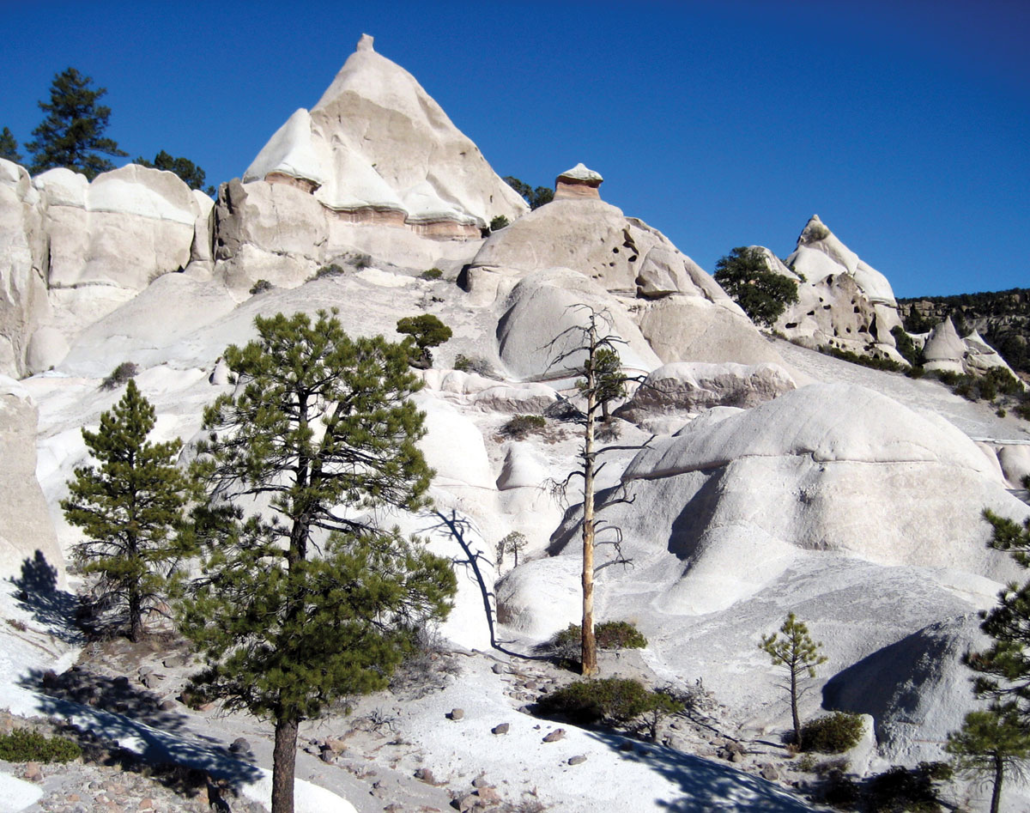
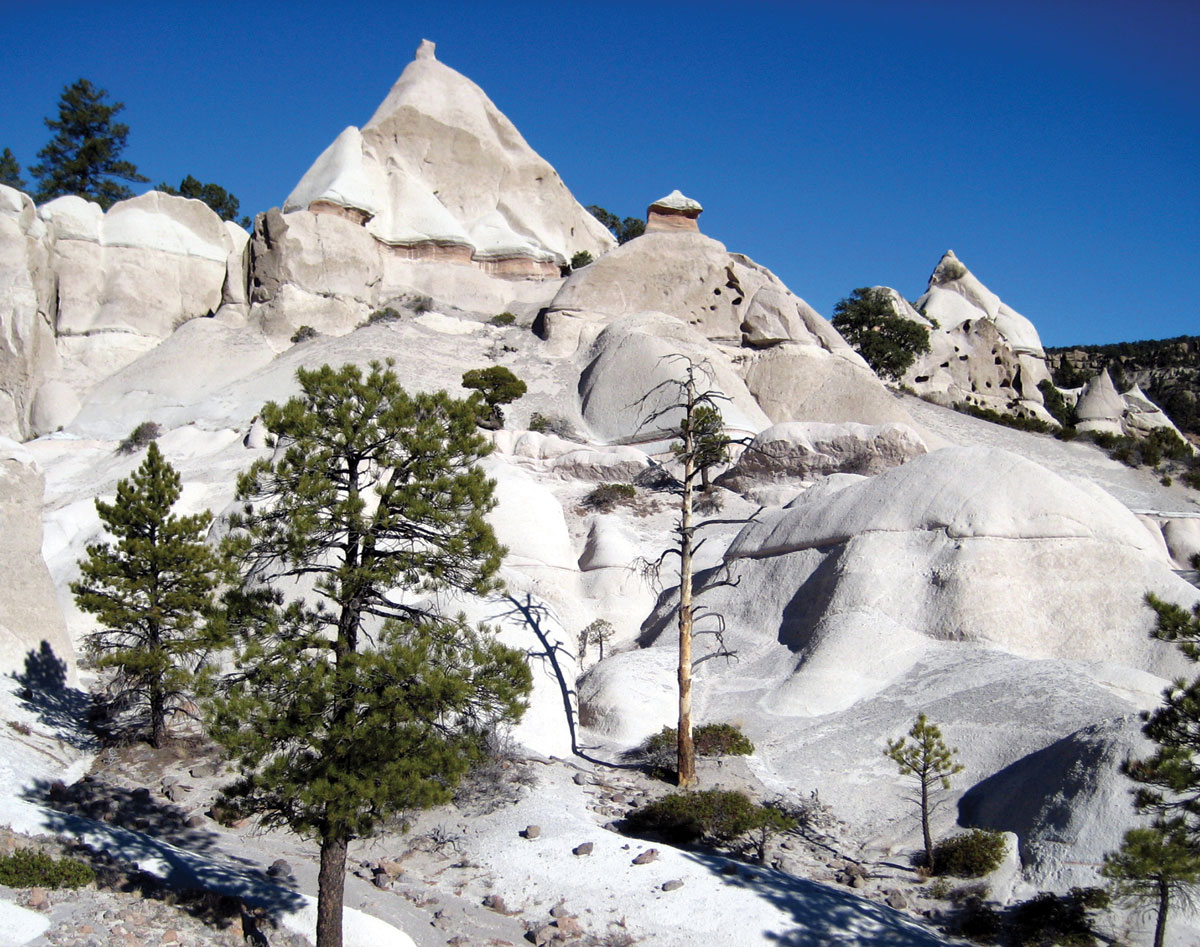
Exposures of the Tuff of Honeycomb Rock at Pine Park.

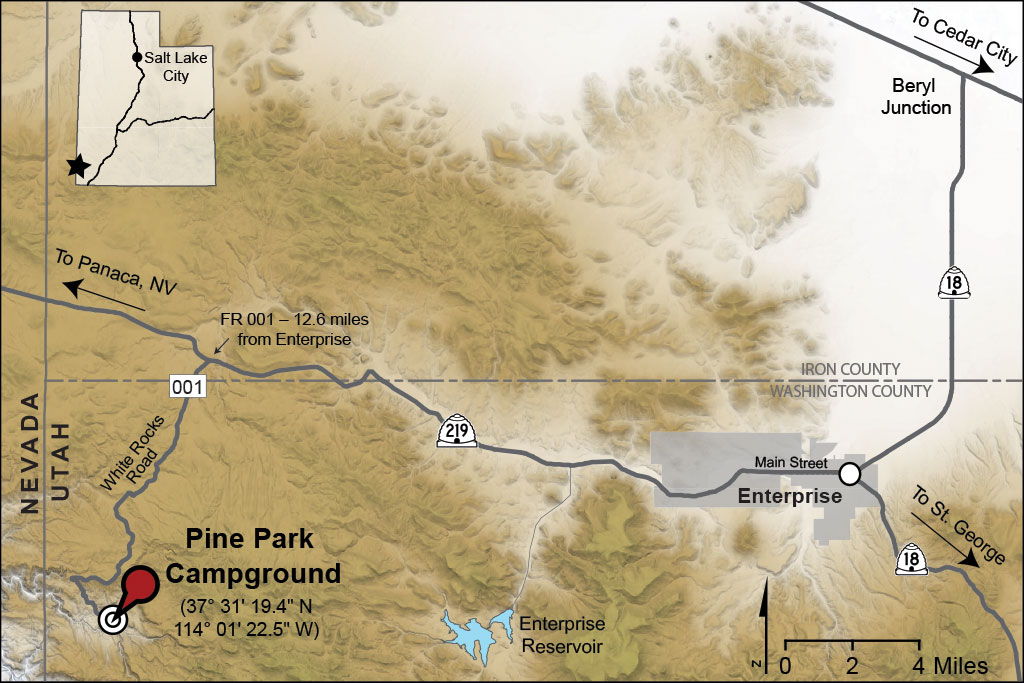
Pine Park is located approximately 20 miles (32km) southwest of Enterprise in the southwest corner of Utah. It is one of several attractions located on the upper Beaver Dam Wash. The region supports a high desert forest of juniper, pinyon, and large ponderosa pine trees, which thrive in the well-drained volcanic soils. The main attractions in Pine Park are bright white volcanic ash-flow tuff exposures that form a landscape of hoodoos, pyramid- and mushroom-shaped domes, and undulating slickrock basins. Many of these vistas resemble the hoodoos and knobs of the better-known Goblin Valley State Park of central Utah, or the Toadstools area near Lake Powell’s Wahweap Bay. However, instead of the familiar sandstone and claystone of Utah’s Colorado Plateau, these spires have eroded from thick deposits of white volcanic ash-flow tuff known as the Tuff of Honeycomb Rock. An ash-flow tuff is a type of rock made of volcanic ash, rock, and gases derived from explosive volcanic eruptions.

A few miles to the west down Pine Park Canyon, at Beaver Dam State Park in Nevada, the same types of ashflow tuff deposits create scenic vistas like those of Pine Park. These two attractions showcase just a small piece of the voluminous ash-flow tuff deposits that blanket the region. Called “supervolcanoes” or “super-eruptions” because of their immense size, these types of eruptions tend to leave behind massive, often miles-wide, craters called calderas instead of the typical pyramid-shaped cones of stratovolcanoes. A caldera’s large, cauldron-like hollow or valley forms after magma erupts and the ground surface above the magma chamber collapses.
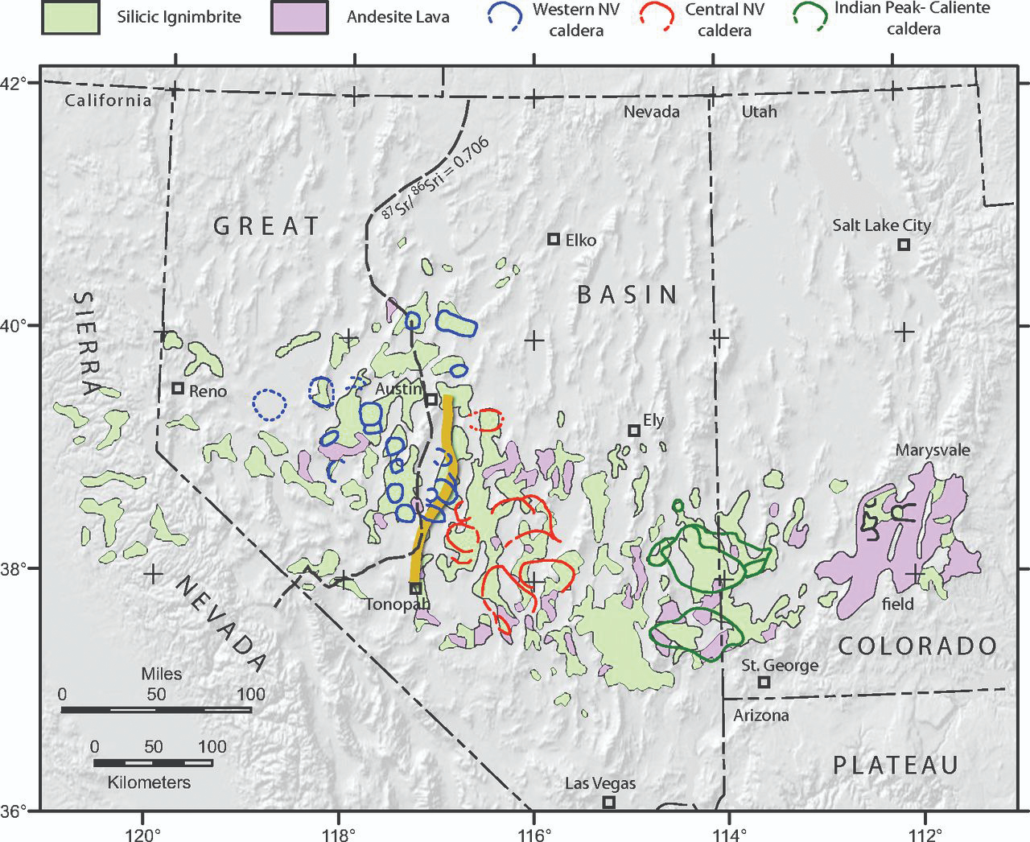
Miocene- to Oligocene-age (12 to 36 million years ago) supervolcanoes, caldera complexes, and volcanic deposits, which stretch from south-central and western Utah through Nevada and eastern California. From Best and others, 2013, Geosphere article: https://doi.org/10.1130/GES00945.1

Pine Park lies at the edge of the ancient Pine Park caldera—one of dozens of calderas spanning from southwestern Utah, across central Nevada, to the border of eastern California. These supervolcanoes were active between 12 and 36 million years ago, when Utah was home to rhinoceros, camels, tortoises, and palm trees. Although the Tuff of Honeycomb Rock that outcrops at Pine Park is locally derived from a smaller ancient caldera, many of the ash-flow tuffs in the area are derived from the nearby Indian Peak–Caliente caldera complex, formed by some of the largest ancient super-eruptions in North America. Geologists have found deposits 2.5 miles (4 km) thick that are believed to have come from a single incredible eruption from the Indian Peak–Caliente caldera complex 30 million years ago. Over 1,300 cubic miles (5,400 km3) of volcanic materials have been found from this eruption spanning from central Utah to central Nevada and from Fillmore, Utah, on the north to Cedar City, Utah, on the south—over 1,000 times the volume of material ejected during the 1980 Mount St. Helens eruption (about 1 cubic mile [4 km3]). And this caldera was only one of up to 20 calderas in the region.

Since the eruption of the volcanoes that created the deposits of Pine Park, extension of the Earth’s crust across the Basin and Range Province has torn apart much of western Utah and has vastly altered the landscape and drainages. Without geologists studying the thick volcanic deposits such as those exposed at Pine Park, people may have never known the extent to which ancient volcanoes altered the landscape of this part of southern Utah.

Share this entry
  • Share on Facebook
  • Share on X
  • Share on WhatsApp
  • Share on Pinterest
  • Share on LinkedIn
  • Share on Tumblr
  • Share on Vk
  • Share on Reddit
  • Share by Mail
https://utahgeology.com/wp-content/uploads/2026/02/image-1.png 947 1200 Lance Weaver https://utahgeology.com/wp-content/uploads/2025/07/utah-geology-site-logo-420px-new.png Lance Weaver2026-02-15 19:04:582026-02-16 02:27:27Pine Park and the Ancient Supervolcanoes of Southwestern Utah

Welcome

About me
Lance Weaver. about me.


Book a Tour

Popular
  • Tracks, Traces & Other Fossils of The Grand Canyon &...January 7, 2025 -
  • When Was The Colorado River Formed?February 21, 2025 -
  • Were the Ice Ages Caused by True Polar Wandering?September 21, 2020 -
  • Navajo SandstoneApril 16, 2015 -
  • The Vishnu SchistNovember 14, 2018 -
  • Take Away Lessons from my Experience with the Jerold Williams...August 10, 2015 -
  • The Geology of Zion National ParkNovember 14, 2018 -
  • Utah’s Three Types of VolcanoesMay 26, 2015 -
Recent
  • When Was The Colorado River Formed?February 21, 2025 -
  • Tracks, Traces & Other Fossils of The Grand Canyon &...January 7, 2025 -
  • Grand Canyon’s Bright Angel Shale (Geology of The...March 10, 2026 -
  • Grand Canyon’s Tapeats Sandstone (Geology of The...March 10, 2026 -
  • Grand Canyon’s Muav Limestone (Geology of The Grand...March 7, 2026 -
  • Grand Canyon’s Redwall Limestone (Geology of The...March 7, 2026 -
  • The Cretaceous (Cretassic) Period: A Geologic Proposition...March 2, 2026 -
  • A Geologic Overview of Lake Powell, UtahFebruary 15, 2026 -
  • Pine Park and the Ancient Supervolcanoes of Southwestern...February 15, 2026 -
  • The Weaver Precessional Polar Oscillation Cycle & Core-Mantle...January 3, 2026 -
Comments
  • Lance WeaverShare your thoughts!June 9, 2026 - by Lance Weaver
  • Lance WeaverIf you want to visit some of these formations check out...May 11, 2026 - by Lance Weaver
  • Mads Erik HusdalThe amount of work you have put in this is mind boggling!...February 23, 2026 - by Mads Erik Husdal
  • Gabor Szuecs dr.Because the pole was not where it is today. Around the year...February 8, 2026 - by Gabor Szuecs dr.
  • Alan FullerUpdate to previous post. After a more thorough read I have...December 30, 2025 - by Alan Fuller
  • Alan FullerFantastic piece of work I think you have basically described...December 26, 2025 - by Alan Fuller
  • Lance WeaverNo. Despite what some say, there are no specific 'angles'...November 21, 2025 - by Lance Weaver
  • Mark RademakerLance, i have read that the cross beds of Checkerboard Mesa...November 9, 2025 - by Mark Rademaker

Follow us on Facebook

UtahGeology
Logo image
Go to facebook page
Join the Facebook community!

Tag Cloud

Frontpage Article Geoarchaeology Geologic Formation Pages Geologic Hiking Guides Images News Uncategorized

Important Pages

Privacy Policy,    About utahgeology.com,    Contact Us,   
Image & Copyright Policy

Relevant Links

  • Utah Geological Survey
  • U.S. Geological Survey
  • Arizona Geology Blog
  • Durango Bill
  • Zion Experiences

Contact Me

Utahgeology is a 501c nonprofit. If you would like to contact me, drop me a line from the contact page. Or if you have questions about geology, call me during normal work hours at the Utah Geological Survey.
© Copyright - UtahGeology - Enfold Theme by Kriesi
  • Link to Facebook
  • Link to Instagram
  • Link to Youtube
Link to: The Weaver Precessional Polar Oscillation Cycle & Core-Mantle Injection Theory Link to: The Weaver Precessional Polar Oscillation Cycle & Core-Mantle Injection Theory The Weaver Precessional Polar Oscillation Cycle & Core-Mantle Injection...Link to: A Geologic Overview of Lake Powell, Utah Link to: A Geologic Overview of Lake Powell, Utah A Geologic Overview of Lake Powell, Utah
Scroll to top Scroll to top Scroll to top