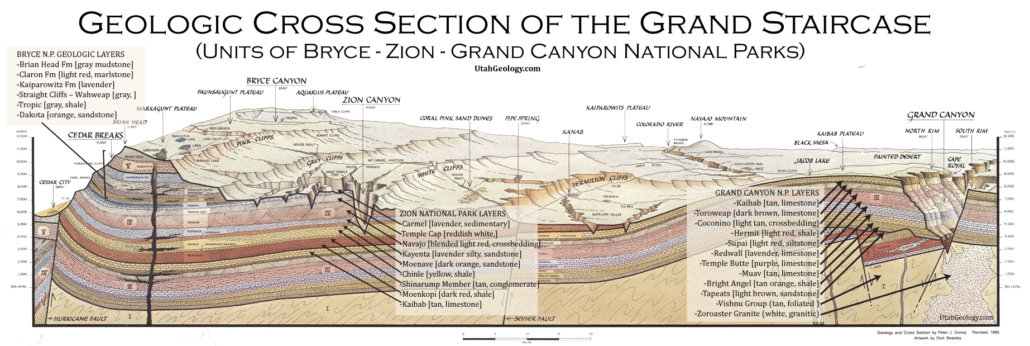
Grand Canyon’s Bright Angel Shale (Geology of The Grand Staircase)
Explore unit thickness in All-in-One App

Grand Staircase Strat Column (Link).

Exposure: The unit is most famous for forming the wide, greenish “Tonto Platform” in the Grand Canyon, Arizona. It is best viewed along the Bright Angel Trail or the North Kaibab Trail, where it creates a distinct recessive slope between the cliff-forming Tapeats Sandstone below and the Muav Limestone above.

Age:  Middle Cambrian (approx. 505–515 Ma)

Lateral Equivalents: Pioche Shale (UT/NV), Langston Fm (Northern UT/ID), Wolsey Shale (WY/MT), Peerless Fm (CO), Carrara Fm (NV)

Depositional Environment: The environment was a distal, shallow marine shelf to subtidal mudflat. It sat below the constant agitation of the surf zone but was shallow enough to be affected by storm waves. The presence of glauconite suggests slow sedimentation rates in a relatively quiet, normal-salinity marine setting.

Paleogeography: The region was located on the western “trailing” passive margin of Laurentia. During the Middle Cambrian, the Southwest was positioned at equatorial latitudes, specifically within the tropical belt. The area consisted of a vast, flooded continental shelf with no significant terrestrial vegetation to hold back sediment.

Tectonics: Tectonically, this was a period of extreme stability following the Neoproterozoic rifting of Rodinia. The lack of mountain building (orogeny) allowed for a remarkably flat landscape, enabling the “Great Unconformity” to be draped by thousands of square miles of flat-lying, minimally deformed marine sediments as sea levels rose.

Climate: The climate was predominantly tropical to subtropical. With no land plants to regulate carbon dioxide or albedo, the Earth was in a “greenhouse” state. Warm, shallow seas covered much of the continent, promoting high calcium carbonate saturation and vibrant, though primitive, biological productivity in the water column.

Features: The unit is notable for its distinct slope-forming weathering pattern and “candy-striped” appearance caused by alternating layers of siltstone and shale. It frequently contains abundant mud-cracks, ripple marks, and green glauconite pellets, which give the shale its characteristic olive-drab to forest-green hue in many canyon exposures.

Fossils: The Bright Angel is a world-class source for Middle Cambrian trilobites, including Alokistocare and Glossopleura. It is also famous for its diverse trace fossils (ichnofossils), brachiopods, and primitive sponges, capturing the rapid diversification of body plans during the Cambrian Explosion within the muddy seafloor sediments.

View looking north from Tuweap area near Toroweap Point.

Description:

The Bright Angel Shale represents a pivotal chapter in the Paleozoic history of the American Southwest, serving as the middle member of the Tonto Group—a classic “transgressive sequence” that records the steady encroachment of the sea onto the North American craton. Formed approximately 505 to 515 million years ago during the Middle Cambrian, the unit consists primarily of fissile, greenish-gray micaceous shales, siltstones, and thin-bedded fine-grained sandstones. As the Sauk megasequence progressed, the high-energy beach environments of the underlying Tapeats Sandstone migrated eastward, giving way to the deeper, quieter waters of the Bright Angel. This depositional shift reflects a deepening marine shelf where fine-grained clastics could settle below the fair-weather wave base. In the modern world, geologists often look to the broad, shallow shelf of the Yellow Sea or parts of the northern Australian shelf as analogs, where sediment-starved epicontinental seas allow for the accumulation of extensive mudflats and subtidal silts.

Deposited along the passive margin of western Laurentia (the ancient core of North America), the Bright Angel Shale is a testament to the larger Cordilleran tectonic context. During this time, the supercontinent Rodinia had finished rifting apart, leaving behind a broad, flat coastal plain. The unit’s distinct “slope-forming” profile in the Grand Canyon is punctuated by intensive bioturbation, specifically the ichnofossil Skolithos and Cruziana—traces of ancient organisms churning through the mud. The geochemical environment was likely dysoxic to oxic, supporting a burgeoning community of marine life that benefited from the nutrient-rich runoff of the barren terrestrial landscape. Because the Cambrian sea transgressed from the west to the east over millions of years, the Bright Angel exhibits significant diachroneity; it is older in the western Grand Canyon and younger as it moves toward the cratonic interior, demonstrating how geologic units “climb” through time during a marine transgression.

On a regional scale, the Bright Angel Shale does not exist in isolation but is part of a massive, interconnected system of Cambrian marine deposits across the Rocky Mountain corridor. In northern Utah and southeastern Idaho, the unit is time-equivalent to the Pioche Shale and parts of the Langston Formation, which similarly record the transition from basal quartzites to trilobite-bearing mudstones. Further north and east into Wyoming and Montana, the Gros Ventre Formation and the Wolsey Shale represent the same sea-level rise, albeit with slight variations in sediment source and mineralogy. In Colorado, the Peerless Formation (often found above the Sawatch Quartzite) serves as the distal, younger equivalent. These units collectively define the “Cambrian Explosion” of life in the West, providing the primary substrate for some of the planet’s first complex reef-building organisms and diverse trilobite assemblages that flourished in the tropical, sun-drenched waters of the Cambrian shelf.

Modern Analog to Utah’s Middle Jurassic
Trade this out with the Indus Delta!

.

Paleogeography or Depiction of Utah during Middle Jurassic

What is the Grand Staircase?

The Grand Staircase is a unique and extensive exposure of Earth’s history, showcasing over 200 million years of sedimentary rock layers. Geologists often liken these layers to a “book,” allowing for a detailed study of the Earth’s past, including changes in climate and environment.

The major sedimentary rock units exposed in the Grand Canyon range in age from 200 million to 600 million years and were deposited in warm shallow seas and near-shore environments. The nearly 40 identified rock layers of Grand Canyon form one of the most studied geologic columns in the world.

[flickr_tags user_id=”95435349@N04″ randomize=”true” margins=”4″ pagination=”numbers” tags=”navajo” max_num_photos=”9″]

[flickr_tags user_id=”95435349@N04″ tags=”chinle, navajo”]

Grand Canyon’s Tapeats Sandstone (Geology of The Grand Staircase)

Explore unit thickness in All-in-One App

Grand Staircase Strat Column (Link).

Exposure: The Tapeats is most spectacularly exposed in the Grand Canyon, Arizona, where it forms the dark, prominent cliff directly above the Inner Gorge. Excellent accessible views are found at the base of the Bright Angel Trail and along the Tonto Trail, where the unit creates a distinct “stair-step” in the canyon’s profile.

Age:  Early to Middle Cambrian (approx. 508–525 Ma)

Lateral Equivalents: Flathead Sandstone (WY/MT), Sawatch Quartzite (CO), Geertsen Canyon Quartzite (UT/ID), Tintic Quartzite (Central UT), Prospect Mountain Quartzite (NV)

Depositional Environment: The environment was a high-energy, tide-dominated nearshore and shoreface setting. It includes beach sands, intertidal flats, and shallow subtidal channels. The presence of large-scale cross-bedding and rounded quartz pebbles indicates powerful water currents and constant wave action that winnowed out finer silts, leaving behind mature, resistant sand.

Paleogeography:During deposition, the Southwest was located on the western passive margin of Laurentia at equatorial latitudes. The area was a vast, low-relief coastal plain transitioning into a broad epicontinental shelf. The lack of terrestrial vegetation meant the coastline was a stark landscape of sand dunes and rocky outcrops.

Tectonics: This period followed the successful rifting of Rodinia, occurring during a tectonically quiet phase. The region experienced thermal subsidence as the crust cooled, allowing the sea to transgress across the “Great Unconformity.” There was very little active deformation, resulting in the widespread, flat-lying nature of these basal sands.

Climate: The climate was tropical to subtropical, as North America straddled the equator. With high atmospheric CO2 levels, the Earth was in a greenhouse state. Intense chemical weathering on the barren continents provided the massive volume of quartz sand, while warm, shallow coastal waters facilitated high energy and sediment transport.

Features: The unit is notable for its resistant, cliff-forming nature and deep brown to reddish-tan coloration. It features spectacular primary sedimentary structures, including meter-scale tabular and trough cross-bedding, ripple marks, and “lag” deposits of well-rounded quartz pebbles at the contact with the underlying Precambrian Schist and Granite.

Fossils: The Tapeats is famous for its ichnofossils (trace fossils), particularly Skolithos—vertical, pipe-like burrows created by suspension-feeding organisms in the surf zone. While body fossils like trilobites are rare due to the high-energy environment, they are occasionally found in the upper, finer-grained transition zones leading into the Bright Angel Shale.

View looking north from Tuweap area near Toroweap Point.

Description:

The Tapeats Sandstone represents the dramatic onset of the Paleozoic Era across the American Southwest, serving as the basal member of the Tonto Group. Formed approximately 508 to 525 million years ago during the Early to Middle Cambrian, the Tapeats is the stratigraphic record of a massive marine transgression—the Sauk Transgression—where rising sea levels pushed the shoreline eastward across the barren crystalline basement of the North American craton. In the Grand Canyon, this unit is famous for draping over the “Great Unconformity,” a staggering erosional gap representing over a billion years of missing geologic time. The formation is primarily composed of cliff-forming, cross-bedded quartz sandstones and conglomerates, reflecting a high-energy depositional environment characterized by migrating sand waves and shoreface currents. Modern analogs can be found in the high-energy, tide-dominated sandy shorelines of the North Sea or the Bay of Fundy, where powerful currents redistribute coarse sediments across a broad, shallow shelf.

The deposition of the Tapeats occurred along the western passive margin of Laurentia, the ancient core of North America. Following the Neoproterozoic rifting of the supercontinent Rodinia, the continental edge subsided, allowing the ocean to spill onto a remarkably flat landscape known as a “peneplain.” Because there were no land plants to stabilize the soil, the terrestrial surface was a stark, rocky wasteland. Weathering produced vast quantities of quartz-rich sand that were transported by wind and ephemeral braided streams toward the encroaching coast. As the sea advanced, these sands were reworked into a complex mosaic of beach, shoreface, and tidal-channel deposits. This process was diachronous, meaning the Tapeats “climbed” in time; it is older in the west (Basin and Range) and becomes progressively younger as it moves toward the continental interior of Arizona and Utah, recording the slow, relentless landward march of the Cambrian tides.

Regionally, the Tapeats Sandstone is part of a vast “blanket sand” that covers much of the Western United States, though it bears different names in adjacent basins. In northern Utah and southeastern Idaho, this basal Cambrian quartzite is known as the Geertsen Canyon Quartzite or the Brigham Group, which similarly rests atop Precambrian basement rock. In Wyoming and Montana, the time-equivalent unit is the Flathead Sandstone, a prolific ridge-former in the Wind River and Bighorn mountains. To the east in Colorado, the Sawatch Quartzite represents the same transgressive event as the sea reached the Ancestral Rocky Mountain region. Collectively, these units represent the first pulse of the Sauk Megasequence, a global sea-level rise that fundamentally restructured the paleogeography of the Cordilleran margin and set the stage for the subsequent “Cambrian Explosion” of marine life.

Modern Analog to Utah’s Middle Jurassic

Trade this out with the Indus Delta!

.

Paleogeography or Depiction of Utah during Middle Jurassic

What is the Grand Staircase?

The Grand Staircase is a unique and extensive exposure of Earth’s history, showcasing over 200 million years of sedimentary rock layers. Geologists often liken these layers to a “book,” allowing for a detailed study of the Earth’s past, including changes in climate and environment.

The major sedimentary rock units exposed in the Grand Canyon range in age from 200 million to 600 million years and were deposited in warm shallow seas and near-shore environments. The nearly 40 identified rock layers of Grand Canyon form one of the most studied geologic columns in the world.

[flickr_tags user_id=”95435349@N04″ randomize=”true” margins=”4″ pagination=”numbers” tags=”navajo” max_num_photos=”9″]

[flickr_tags user_id=”95435349@N04″ tags=”chinle, navajo”]

Grand Canyon’s Muav Limestone (Geology of The Grand Staircase)

Explore unit thickness in All-in-One App

Grand Staircase Strat Column (Link).

Exposure: Best seen in the Grand Canyon as the top layer of the Tonto Platform (e.g., along the Bright Angel Trail). It also crops out in the Virgin River Gorge of Arizona/Utah and the Frenchman Mountain area near Las Vegas.

Age:  Middle Cambrian, 505-495 million years ago.

Depositional Environment: Primarily a shallow marine carbonate shelf. It transitioned between subtidal flats and deeper offshore “ramp” environments. The frequent silt partings suggest a fluctuating sea level where muddy terrestrial runoff occasionally mixed with the clear-water lime muds of the open shelf.

Paleogeography: Part of the western margin of Laurentia. The region was located near the equator, meaning the “Southwest” was actually a tropical, westward-facing coastline at the time. The vast, flat interior of the continent lay to the east, largely devoid of land plants.

Tectonics: Occurred during a passive margin phase. The crust was cooling and subsiding following the earlier breakup of the supercontinent Rodinia. There was very little tectonic deformation or volcanic activity, leading to the remarkably horizontal and consistent layering seen across the Colorado Plateau today.

Climate: Tropical to subtropical. Because Laurentia sat astride the equator, the waters were warm and conducive to carbonate chemistry. The lack of land vegetation meant that weathering on the continent was purely chemical and physical, leading to high mineral runoff into the warming Cambrian seas.

Features: Notable for its mottled, “edgewise” conglomerates and thin, silty interbeds. The limestone often weathers to a dull orange or buff color on the surface, but when freshly broken, it reveals a dark, fine-grained gray or green interior. It forms distinctive “stairstep” cliffs.

Fossils: Contains a variety of Middle Cambrian marine life, most notably trilobites (like Alokistocare), brachiopods, and hyoliths. However, the most pervasive “fossils” are ichnofossils—the preserved burrows and tracks of unknown worm-like creatures that created the formation’s signature mottled texture through bioturbation.

View looking north from Tuweap area near Toroweap Point.

Description:

The Muav Limestone represents the climactic, “deepest-water” chapter of the classic Tonto Group sequence, a geologic trilogy that records the Great Cambrian Transgression across the Southwest. While the underlying Tapeats Sandstone and Bright Angel Shale represent beach and muddy near-shore environments, the Muav signifies a time when the sea had moved far enough inland to allow for the deposition of carbonate muds. In the Grand Canyon and southern Utah, the Muav is a cliff-forming unit, though its ledges are often “stairstepped” or mottled compared to the sheer face of the much younger Redwall Limestone. It is primarily composed of calcareous (lime-rich) and dolomitic mudstones, characterized by a unique “mottled” appearance caused by ancient burrowing organisms that churned the seafloor before the sediment hardened—a process known as bioturbation.

Depositionally, the Muav formed on a vast, shallow marine shelf known as an epicontinental sea. During the Middle Cambrian (approx. 505 Ma), North America—then part of the paleocontinent Laurentia—was tilted and partially submerged. The Muav was deposited in the “middle shelf” zone, where the water was clear enough for carbonate precipitation but still close enough to the coast to receive occasional pulses of silt and clay. These pulses created the thin, micaceous partings that separate the thicker limestone beds. A modern analog for this environment would be the inner Sahul Shelf off the northern coast of Australia or parts of the Yucatán Platform, where broad, shallow carbonate ramps transition from muddy shorelines to clear-water limestone-producing factories.

In the broader Cordilleran context, the Muav Limestone is a testament to the “passive margin” phase of Western North America. During this period, there were no towering mountains to the west; instead, the continent thinned out into a wide, submerged plain. The Muav thickens significantly as you move westward toward the Cordilleran Miogeocline in Nevada, reflecting a seafloor that was gently sloping into deeper oceanic basins. This stable tectonic setting allowed for the accumulation of hundreds of feet of sediment without the interruption of volcanic activity or mountain building. However, the top of the Muav is marked by a dramatic unconformity; a massive gap in the geologic record exists between the Muav and the overlying Devonian rocks, where millions of years of history were eroded away before the next layer was laid down.

Modern Analog to Utah’s Middle Jurassic

Trade this out with the Indus Delta!

.

Paleogeography or Depiction of Utah during Middle Jurassic

What is the Grand Staircase?

The Grand Staircase is a unique and extensive exposure of Earth’s history, showcasing over 200 million years of sedimentary rock layers. Geologists often liken these layers to a “book,” allowing for a detailed study of the Earth’s past, including changes in climate and environment.

The major sedimentary rock units exposed in the Grand Canyon range in age from 200 million to 600 million years and were deposited in warm shallow seas and near-shore environments. The nearly 40 identified rock layers of Grand Canyon form one of the most studied geologic columns in the world.

[flickr_tags user_id=”95435349@N04″ randomize=”true” margins=”4″ pagination=”numbers” tags=”navajo” max_num_photos=”9″]

[flickr_tags user_id=”95435349@N04″ tags=”chinle, navajo”]

Grand Canyon’s Redwall Limestone (Geology of The Grand Staircase)

Explore unit thickness in All-in-One App

Grand Staircase Strat Column (Link).

Exposure:

Prominent throughout the Grand Canyon (e.g., South Kaibab Trail); also visible in the Virgin River Gorge, Pavant Range, and San Rafael Swell.

Age:  Mississippian, 359-330 million years ago.

Depositional Environment: High-energy shallow marine shelf. Specifically, a carbonate platform featuring oolitic shoals, crinoid thickets, and lime-mud flats distal from continental sediment sources.

Paleogeography: Located on the western passive margin of Laurentia. The region sat at approximately 10°–20° North latitude, effectively making it a tropical coastal shelf.

Tectonics: Characterized by a stable cratonic platform with slow subsidence. Distal to the developing Antler Orogeny (Cordilleran arc) to the west; largely undeformed until the Laramide.

Climate: Tropical to subtropical; warm, clear, and well-oxygenated waters promoted massive biological carbonate production and the growth of widespread coral and bryozoan colonies.

Features: Notable for its massive verticality and Thunder Springs Member, which contains distinctive alternating bands of gray limestone and dark, weather-resistant chert lenses.

Fossils: Extremely fossiliferous; dominated by crinoid columnals, spiriferid brachiopods, rugose (horn) corals, and bryozoans. Rare nautiloid “death beds” and fish teeth are also found

View looking north from Tuweap area near Toroweap Point.

Description:

The Redwall Limestone is perhaps the most iconic architectural element of the Grand Canyon, forming a singular, vertical precipice that averages 500 to 800 feet in height. Despite its name and vibrant exterior, the formation is actually a light-gray, high-purity carbonate (~99% limestone and dolomite); its famous “red wall” is merely a superficial iron-oxide stain leached from the overlying Supai Group and Hermit Formation. Depositionally, the Redwall represents a massive marine transgression during the Mississippian Period (approx. 340 million years ago), when a warm, clear, epicontinental sea flooded the stable North American craton. This shallow-water shelf environment was largely free of terrigeneous (land-derived) sediment, allowing for the accumulation of thick successions of bioclastic lime muds and sands.

From a broader tectonic perspective, the Redwall Limestone was deposited along a passive margin on the western edge of the Laurentian continent, situated within the subtropics. This was a time of relative tectonic quiescence for the Southwest, preceding the dramatic crustal shortening of the later Paleozoic. To the west, the Cordilleran Miogeocline was beginning to transition into a more active setting as the Antler Orogeny initiated in present-day Nevada, yet the Colorado Plateau remained a stable, subsiding platform. The unit is divided into four distinct members—the Whitmore Wash, Thunder Springs, Mooney Falls, and Horseshoe Mesa—which record two major cycles of rising and falling sea levels (transgressions and regressions), resulting in a complex internal stratigraphy of massive limestone ledges and chert-rich layers.

A modern analog for the Redwall’s depositional environment can be found in the Great Bahama Bank. Like the ancient Mississippian seaway, the Bahamas feature a broad, shallow carbonate platform where biological activity—rather than river-fed silt—drives sedimentation. In this clear, sunlit water, a diverse community of benthos thrived, including crinoids, brachiopods, and corals. Eventually, as the sea retreated at the end of the Mississippian, the exposed limestone surface underwent intense subaerial weathering. This led to a widespread paleokarst landscape characterized by sinkholes and caverns, many of which were later filled with the red mudstones of the Surprise Canyon Formation and Supai Group, creating a significant disconformity (a gap in the geologic record).

Modern Analog to Utah’s Middle Jurassic

Trade this out with the Indus Delta!

.

Paleogeography or Depiction of Utah during Middle Jurassic

What is the Grand Staircase?

The Grand Staircase is a unique and extensive exposure of Earth’s history, showcasing over 200 million years of sedimentary rock layers. Geologists often liken these layers to a “book,” allowing for a detailed study of the Earth’s past, including changes in climate and environment.

The major sedimentary rock units exposed in the Grand Canyon range in age from 200 million to 600 million years and were deposited in warm shallow seas and near-shore environments. The nearly 40 identified rock layers of Grand Canyon form one of the most studied geologic columns in the world.

[flickr_tags user_id=”95435349@N04″ randomize=”true” margins=”4″ pagination=”numbers” tags=”navajo” max_num_photos=”9″]

[flickr_tags user_id=”95435349@N04″ tags=”chinle, navajo”]

Supai & Hermosa Group / Weber Sandstone (Geology of The Grand Staircase)

Explore unit thickness in All-in-One App

Grand Staircase Strat Column (Link).

Exposure:

The Supai Group is seen throughout the Grand Canyon. Moving northward it transitions into the Hermosa Group and can be Seen in the Goosenecks area and especially in Canyonlands. Farther north, the time equivalent Weber Sandstone of the Vernal area is particularly notable.

Age:  Early Permian, 315-285 million years ago.

Depositional Environment: deposited in a nearshore eolian, or wind-blown, environment. Specifically, it formed along the western edge of the ancient Pangaean Supercontinent. The Hermit Shale, which sits above the Esplanade, was deposited in a fluvial and coastal plain environment. The Esplanade Sandstone is part of the Supai Group, which generally represents a diverse range of environments, but eolian sands are most prevalent.

Paleogeography: Like most Grand Canyon units, the region was likely the western coast of the North American craton during much of the Paleozoic.

Tectonics: The collision of the Gondwana Plate with the North American Plate resulted in the Uncompahgre highland and thick deposits of the Paradox Basin of this age.

Climate: probably dry, but also likely prone to wide temperature swings associated with Karoo Glaciation of South Africa, Antarctica & South America (Gondwana).

Features: The Supai Group in the Grand Canyon is notable for its interbedded reddish shales, buff or pinkish buff sandstones, and gray limestones. It forms a prominent red staircase on the canyon walls, below the Hermit Shale and above the Redwall Limestone. The Supai Group also contains fossils, including fern-like leaves, reptile tracks, and various marine life.

Prominent Cliffs and Stepping Stones: The resistant sandstones within the Supai Group have eroded into thick, massive beds that form prominent, vertical cliffs. The overall effect of the interbedded rocks is a series of red staircases descending from the higher layers.

Fossils: Fossils are found in these layers, including fern-like leaves, reptile tracks, and various marine fossils like brachiopods, trilobites, seaweed, and sponges.
Geological Context:
.
The Supai Group was deposited in a variety of environments, including coastal lowlands, arid coasts, and rivers/swamps.

View looking north from Tuweap area near Toroweap Point.

Description:

The Supai Group consists of alternatingly interbedded soft, reddish shales and sandy; hard, buff or pinkish buff sandstones; and, in its lower part, hard, gray limestones. Most the sandstone consist of thick, massive beds that erode as prominent, vertical cliffs. The limestones also erode to form erode as prominent, vertical cliffs. The beds of shale and laminated sandstone weather as slopes. The alternation of hard and soft beds form a distinct step-like profile, which consists of alternating cliffs and slopes. The Supai Group overlies either the Redwall Limestone or Surprise canyon Formation and underlies the Hermit Formation.

This topographic profile of the Supai Group is consistent enough that it was initially divided into five subdivisions based upon the cliff versus its slope-forming character and, thus, indirectly on associated lithology within the Grand Canyon region. They are the (1.) Upper cliff unit, locally includes a receding ledge unit (Esplanade cliff); (2.) Upper slope unit; (3.) Middle cliff unit; (4.) Middle slope unit; (5.) Lower cliff and slope unit. These units can be traced throughout the Grand Canyon as they differ remarkably little from one end to the other. However, westward, the slope units do become less conspicuous. In particular, the middle slope unit becomes so weakly developed in the western Grand Cayon region, that the lower and middle cliff units seem to merge together such that lower and middle cliff units appear to merge together.

In 1975, McKee incorporated specific key beds, fauna zones, and erosion surfaces into the above topographic units to define the Watahomigi formation, Manakacha formation, Wescogame Formations and Esplanade Sandstone. Most important to defining and mapping these formations are three key beds, in addition to the basal conglomerate underlying the Redwall Limestone and Surprise canyon Formation, consisting of widespread, lithologically distinct, conglomerates. Two of these of conglomerates are associated with marked erosional surfaces and, thus, likely represent regional unconformities. Marine fossils that occur above and below. these conglomerates also indicate that represent significant periods of nondeposition and erosion.

The deposits of the Supai Group accumulated during multiple transgressive-regressive cycles associted with major sea level fluctuations reflecting changes in the volume of continetal ice sheets resulting from glacial – interglacial cycles. As a result of significant chnages in eustatic sea level locally modulated by local subsidence or uplift. As sea level fluctulated, fluvial, eolian, tidal, and shallow marine environments associated with a broad coastal plain shifted back and forth across the Grand Canyon area resulting in the cyclic deposition red beds, eolian sandstones, and marine limestones. Limestone beds represent the shallow marine limestone deposited during highstands of sea levels during maximum transgression. Unconformities characterized by paleovalleys and erosion surfaces covered with conglomerates represent lowstands of sea level during which river eroded deeply into coastal plains. The cyclic deposition of these sediments began with latest Mississippian and continued through the Pennsylvanian

Modern Analog to Utah’s Middle Jurassic

Trade this out with the Indus Delta!

.

Paleogeography or Depiction of Utah during Middle Jurassic

What is the Grand Staircase?

The Grand Staircase is a unique and extensive exposure of Earth’s history, showcasing over 200 million years of sedimentary rock layers. Geologists often liken these layers to a “book,” allowing for a detailed study of the Earth’s past, including changes in climate and environment.

The major sedimentary rock units exposed in the Grand Canyon range in age from 200 million to 600 million years and were deposited in warm shallow seas and near-shore environments. The nearly 40 identified rock layers of Grand Canyon form one of the most studied geologic columns in the world.

[flickr_tags user_id=”95435349@N04″ randomize=”true” margins=”4″ pagination=”numbers” tags=”navajo” max_num_photos=”9″]

[flickr_tags user_id=”95435349@N04″ tags=”chinle, navajo”]

Esplanade Sandstone & Cutler Cedar Mesa Sandstone (Geology of The Grand Canyon)

Explore unit thickness in All-in-One App

Grand Staircase Strat Column (Link).

Exposure:

The Esplanade Sandstone is the upper member of the Supai Group and forms a prominent bench visible throughout the Grand Canyon. It is time equivalent to the upper Culter Group units, the Cedar Mesa & Elephant Canyon Formations.

Age:  Early Permian, 290–294 million years ago.

Depositional Environment: deposited in a nearshore eolian, or wind-blown, environment. Specifically, it formed along the western edge of the ancient Pangaean Supercontinent. The Hermit Shale, which sits above the Esplanade, was deposited in a fluvial and coastal plain environment. The Esplanade Sandstone is part of the Supai Group, which generally represents a diverse range of environments, but eolian sands are most prevalent.

Paleogeography: Like most Grand Canyon units, the region was likely the western coast of the North American craton during much of the Paleozoic.

Tectonics: The collision of the Gondwana Plate with the North American Plate resulted in the Uncompahgre highland.

Climate: generally dry, with eolian (wind-blown) environments prevalent

Features: The Esplanade/Cedar Mesa Sandstones are a significant feature of the Grand Canyon & Canyonlands, forming a prominent shelf or terrace about a fourth of the way down from the rim. It’s a resistant sandstone, dark red in color, and plays a crucial role in the canyon’s landscape. This rock unit is a key element in creating a “canyon within a canyon” effect, as the Hermit Formation overlies it, forming the slopes below.

The Esplanade Sandstone is characterized by its cliff-forming nature and resistance to erosion, leading to its distinctive shelf formation. It’s also notable for its origin, formed from desert sand dunes that were subsequently compacted and cemented over long geological timescales. This formation also supports a unique ecosystem, with cyanobacteria, lichens, and mosses thriving on its surface, contributing to the overall biodiversity of the canyon.

The Esplanade Sandstone’s presence is particularly visible at locations like Toroweap Overlook and the east side of the canyon. The Esplanade Route trail, named after the sandstone, further highlights its prominence in the canyon’s landscape. Its resistant nature and distinctive color make it a visually striking and geologically important part of the Grand Canyon’s features.

Similarly, the Cedar Mesa forms a prominent shelf of the Hite region and may be lithologically equivalent as well as time equivalent (research this).

View looking north from Tuweap area near Toroweap Point.
Detailed schematic of the units of the Culter formation. (see full poster at this link).

Description:

The Lower Permian Esplanade Sandstone is a cliff-forming, resistant sandstone, dark red, geologic unit found in the Grand Canyon. The rock unit forms a resistant shelf in the west Grand Canyon, south side of the Colorado River, at the east of the Toroweap Fault, down-dropped to west, southeast of Toroweap Overlook (North Rim, at Lava Falls), and west of Havasupai. The red, sandstone shelf, The Esplanade is about 20-mi long. At Toroweap Overlook region, Toroweap Valley with Vulcan’s ThroneUinkaret volcanic field, the resistant Esplanade Sandstone is described in access routes exploring the Toroweap Lake area (Hike 17, Vulcans Throne).[2]

The Esplanade Route–(trail), of the east Grand Canyon is also named for the Esplanade Sandstone. The coeval sandstone geologic unit from eastern Utah is the Cedar Mesa Sandstone

The Supai Group members were created from marine (oceanic) sequences of marine transgression, and regression, thus the alternating sandstone, siltstones, conglomerate subsections (facies); the subsections are not always a continuous transition into the above section, mostly due to ocean levels, falling, or rising, glaciation, or regional subsidence–(basins, etc.) or uplift of land. Today’s Wasatch Front is the approximate lineage, NNE to SSW of the western coast region of North America from where the oceans transgressed. The ancient Antler Mountains–(Antler orogeny, off-shore volcanic island arch(es)), of ancient Nevada supplied material, from the west, off the ‘ancestral’ West Coast. The continent supplied material from the east, both directions supplying the offshore basin, the Cordilleran Basin which became part of the Basin and Range Province, in later epochs. Three other basins were involved in this history: southwest of the Ancestral Rocky Mountains was the Paradox Basin–(eastern Utah to Southwest Colorado), northeast was the Central Colorado Basin–(NW Colorado, NE Utah, SW Wyoming); the Oquirrh Basin was north-northwest, at present day northwest Utah.

Modern Analog to Utah’s Middle Jurassic

Trade this out with the Indus Delta!

.

Paleogeography or Depiction of Utah during Middle Jurassic

What is the Grand Staircase?

The Grand Staircase is a unique and extensive exposure of Earth’s history, showcasing over 200 million years of sedimentary rock layers. Geologists often liken these layers to a “book,” allowing for a detailed study of the Earth’s past, including changes in climate and environment.

The major sedimentary rock units exposed in the Grand Canyon range in age from 200 million to 600 million years and were deposited in warm shallow seas and near-shore environments. The nearly 40 identified rock layers of Grand Canyon form one of the most studied geologic columns in the world.

[flickr_tags user_id=”95435349@N04″ randomize=”true” margins=”4″ pagination=”numbers” tags=”navajo” max_num_photos=”9″]

[flickr_tags user_id=”95435349@N04″ tags=”chinle, navajo”]
Hermit/Organ Rock (Geology of The Grand Canyon)

Explore unit thickness in All-in-One App

Age:  Early Permian (Cisuralian); approximately 285 to 275 million years ago (Ma).

Grand Staircase Strat Column (Link).

Exposure: Easily identified as the wide, brick-red slope below the Coconino Sandstone. Best seen along the Bright Angel Trail at the “Hermit Basin” or from the Desert View Watchtower. It is also well-exposed in the Hurricane Cliffs of Southern Utah.

Age:  Early Permian (Cisuralian); approximately 285 to 275 million years ago (Ma).

Lateral Equivalents: Organ Rock Fm of Cutler Group (Southeast UT); Abo Formation (NM); Maroon Formation (CO); Queantoweap Sandstone (Western Grand Canyon/NV); Wells Formation (ID). SADONA’s Schnelby Hill Formation, sits between the Hermit & Coconino ss.

Depositional Environment: Semi-arid coastal plain and river floodplains. The environment featured meandering streams, sluggish deltas, and expansive mudflats. Frequent subaerial exposure is evidenced by mud cracks, ripple marks, and the preservation of terrestrial plant fossils in fine-grained silt.

Paleogeography: Located on the western edge of the supercontinent Pangea. The region was situated at approximately 10° North latitude, effectively placing the Southwest in a tropical to subtropical belt near the paleo-equator, bordered by a shallow sea to the west.

Tectonics: Deposited during the Ancestral Rocky Mountain orogeny. While the plateau remained a stable block, the nearby uplifting mountains (like the Uncompahgre Uplift) provided the sediment. It preceded the more intense Sonoman Orogeny that would eventually affect the western Cordilleran margin.

Climate: Semi-arid and monsoonal. High temperatures and seasonal rainfall led to periodic flooding and long periods of drying. The high evaporation rates and atmospheric exposure of sediments allowed iron minerals to oxidize, giving the formation its characteristic deep red color.

Features: Notable for its slope-forming morphology and vivid crimson color. It contains remarkably preserved primary structures like mud cracks, raindrop impressions, and ripple marks. In some locations, the unit fills deep paleochannels cut into the underlying rocks.

Fossils: Renowned for its Permian flora, including seed ferns like Supaiia and Walchia (conifers). It also contains vertebrate trackways of early tetrapods (primitive reptiles and amphibians) and rare insect wings, providing a crucial record of Early Permian terrestrial life.

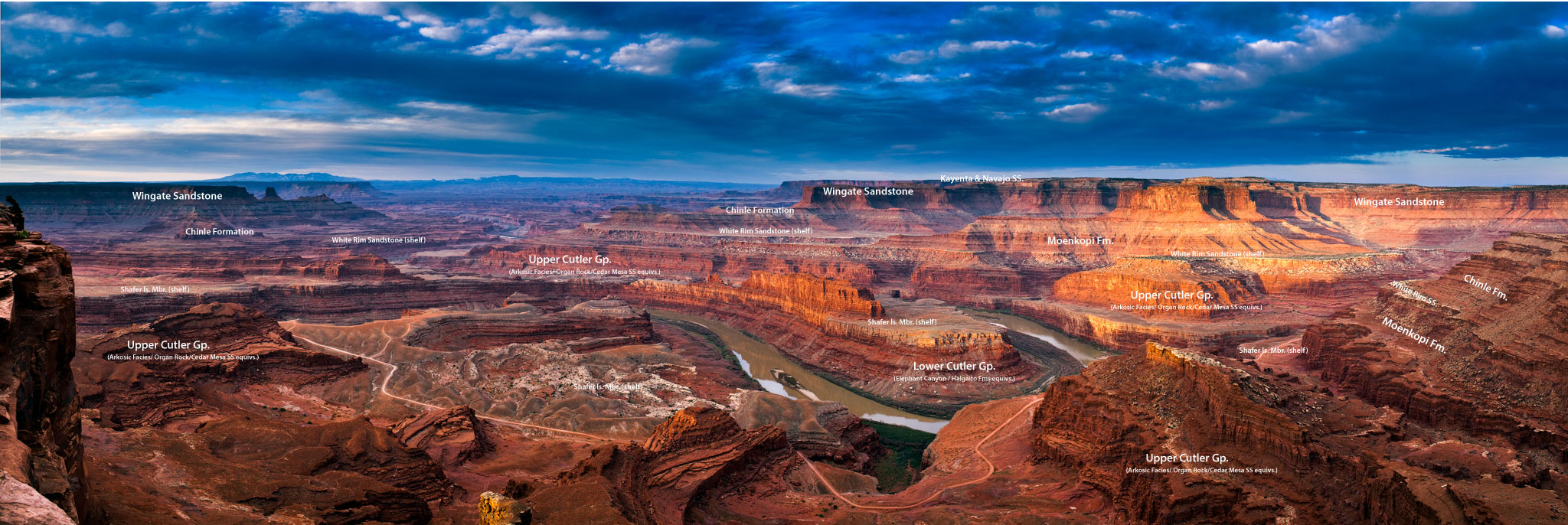
Upper Permian equivalent layers in the Moab/Canyonlands region.
Note that the Moenkopi/Chinle sit uncomformably on the DeChelly (Coconino eqv.)
White Rim SS in Canyonlands National Park. Chinle seen in upper background.
The White Rim forms a cap rock in many parts of the state.
Detailed schematic of the units of the Culter formation. (see full poster at this link).

Description:

The Hermit Formation (traditionally called the Hermit Shale) is one of the most visually striking units of the Grand Canyon, manifesting as a deep-red, recessive slope situated directly beneath the vertical cliffs of the Coconino Sandstone. This formation represents a significant transition in the Permian geologic record, moving away from the marine-dominated carbonate systems of the earlier Paleozoic toward a terrestrial, siliciclastic environment. The unit is primarily composed of siltstone, mudstone, and fine-grained sandstone, all heavily pigmented by hematite (iron oxide). This oxidation occurred as sediment was exposed to the atmosphere in a subaerial setting, creating the “red beds” that define the middle elevations of the canyon walls. In the Grand Canyon, the Hermit sits upon an erosional unconformity, having been deposited into broad, shallow valleys carved into the underlying Supai Group.

Depositionally, the Hermit Formation formed within a vast prograding coastal plain and river delta system. During the Early Permian (approx. 280 Ma), sluggish, meandering rivers flowed southwestward across the stable craton toward the sea. These river systems deposited fine-grained silts and clays across wide floodplains, while occasional flash floods spread sand across the landscape. The environment was periodically desiccated, leading to the formation of mud cracks and the preservation of delicate rain-drop impressions. A modern analog for this setting can be found in the Fly River Delta of Papua New Guinea or the Burdekin River in Australia, where broad, low-gradient coastal plains are subject to seasonal wetting and drying, resulting in extensive fine-grained sediment accumulation.

In the broader Cordilleran tectonic context, the Hermit Formation was deposited during the assembly of the supercontinent Pangea. While the Colorado Plateau remained a relatively stable platform, the collision of Gondwana with Laurasia to the east was creating the Ancestral Rocky Mountains. These nearby uplifts provided the source material for the Hermit’s sediments. To the west, the subduction zone along the continental margin was beginning to influence the regional stress field, though the plateau itself experienced mostly gentle subsidence rather than intense deformation. Regionally, the Hermit is time-equivalent to several significant units: it correlates with the lower portions of the Cutler Group (specifically the Halgaito and Cedar Mesa formations) in San Juan County, Utah, the Abo Formation in New Mexico, and parts of the Maroon Formation in Colorado and the Wells Formation in Idaho.

Modern Analog to Utah’s Middle Jurassic

Trade this out with the Indus Delta!

.

Paleogeography or Depiction of Utah during Middle Jurassic

What is the Grand Staircase?

The Grand Staircase is a unique and extensive exposure of Earth’s history, showcasing over 200 million years of sedimentary rock layers. Geologists often liken these layers to a “book,” allowing for a detailed study of the Earth’s past, including changes in climate and environment.

The major sedimentary rock units exposed in the Grand Canyon range in age from 200 million to 600 million years and were deposited in warm shallow seas and near-shore environments. The nearly 40 identified rock layers of Grand Canyon form one of the most studied geologic columns in the world.

[flickr_tags user_id=”95435349@N04″ randomize=”true” margins=”4″ pagination=”numbers” tags=”navajo” max_num_photos=”9″]

[flickr_tags user_id=”95435349@N04″ tags=”chinle, navajo”]

Toroweap/Coconino/White Rim Sandstone (Geology of The Grand Canyon)

Explore unit thickness in All-in-One App

Grand Staircase Strat Column (Link).

Exposure:

The Toroweap & White Rim Sandtones are best seen in Southern Utah and Northern Arizona.

Age:  Early Permian, 280 million years ago.

Depositional Environment: Coastal dune field (eolian with some marine transgressions). Marine transgressions, terrestrial wind-blown sand, coastal environments laid down the Kaibab, Toroweap, and Coconino formations. At different time, the marine waters came from the west, and receded and re-transgressed. The Coconino Formation represents a regional subaerial sea of sand that existed during a major regression. The Toroweap Formation represents a major marine transgression into the Grand canyon area during which red beds of the Seligman Member accumulated in supratidal, tidal, and terrestrial coastal plain environments. The overlying limestones of the Brady Canyon Member accumulated in open and brackish-water environments during the maximum extent of the marine transgression. A brief regression buried the sediments of the Brady Canyon Member under additional supratidal, tidal, and terrestrial coastal plain red beds of the Woods Ranch Member. The two members of the overlying Kiabab Limestone represent two additional major marine transgression into the Grand Canyon region.

Paleogeography: Sediment deposition was affected by the Uncompahgre uplift , but by the end of the Permian the Uncompahgre mountains had been worn down and was not longer a major sediment source.

Tectonics: The collision of the Gondwana Plate with the North American Plate resulted in the Uncompahgre highland.

Climate: Warm current winds

Features: The White Rim Sandstone is the upper member of the Permian Cutler Croup of rocks.  The White Rim Sandstone gets its name from the white color that is due to bleaching from hydrocarbons (organic compounds). This formation often creates a white band found along canyon rims where it is often relatively thin. The White Rim Sandstone is a cliff-forming formation consisting of fine- to coarse-grained sandstone (Condon, 1997).  This sandstone commonly displays large scale, high-angle cross-beds (dipping sediment layers) deposited by wind blown dunes. The thickness of this formation ranges from 5 to 75 feet thick (Morris, 2003).  The depositional environment that this was deposited in was a coastal dune field that was intermittently flooded by marine water resulting is some reworking of sediments (Komola and Chan, 1988).  The White Rim Sandstone can be viewed from the Goosenecks Overlook at the bottom of Sulphur Creek Canyon in Capitol Reef National Park.

Upper Permian equivalent layers in the Moab/Canyonlands region.
White Rim SS in Canyonlands National Park. Chinle seen in upper background.
The White Rim forms a cap rock in many parts of the state.
Detailed schematic of the units of the Culter formation. (see full poster at this link).

Description:

The White Rim Sandstone is a sandstone geologic formation located in southeastern Utah. It is the last member of the Permian Cutler Group, and overlies the major Organ Rock Formation and Cedar Mesa Sandstone; and again overlies thinner units of the Elephant Canyon and Halgaito Formations.

The White Rim is eponymous, as the sandstone is named for its prominent white color, and forms the rims of cliffs.

It is the continental geologic formation deposited at the time of marine transgressions during the Early to Middle Permian Period.

The coeval Toroweap Formation was laid down under marine conditions along the southwest margin of the North American continent and is found in northwest Arizona layered between Coconino Sandstone and the Kaibab Formation. The Toroweap is mostly from the Grand Canyon and just eastwards to Lee’s Ferry-(Colorado River, Grand Canyon), south to the Verde Valley region (Sedona, Sycamore Canyon, Oak Creek Canyon), but the Toroweap also occurs within sections in southeast Utah, and also became overlain by the Kaibab Formation, specifically at the Circle Cliffs, west of the Waterpocket Fold.

Toroweap Description:

The Toroweap Formation exhibits well-defined lateral and vertical changes in facies over its outcrop. In the western extent of its outcrop in the Grand Canyon region and adjacent parts of Utah and Nevada, the Toroweap Formation is readily subdivided, in ascending order, into the Seligman, Brady Canyon, and Woods Ranch members. Two of these members (Seligman and Woods Ranch members ) consist of red beds and evaporites (gypsum) and are separated by a fossiliferous limestone member (Brady Canyon Member). The red beds of the Seligman and Woods Ranch members are largely of soft, friable sediments, which rapidly weather into slopes, The Brady Canyon Member is a resistant limestone which characteristically stands up as a prominent cliff between the slopes of the Seligman and Woods Ranch members. Further eastward, the Brady Canyon Member disappears, and the two red bed members merged together into an undivided Toroweap Formation. Further east, the red beds grade laterally into cross-bedded sandstones of the Sand Cave Member of the Coconino Sandstone.[4][9][10]

The Seligman Member of the Toroweap formation largely consists of fine-grained, red and yellow sandstone. It typically exhibits flat or irregular bedding. Its maximum observed thickness is about 50 ft (15 m) and in most places is no thicker than 45 ft (14 m). At its upper contact, the Seligman Member grades upwards through a transitional zone of alternating beds of sandstone and limestone into the fossiliferous limestone of the Brady Canyon Member. In Grand Wash Canyon on Lake Mead, the sandstones of the Seligman Member contain a very conspicuous layer of breccia, interpreted to be an intraformational conglomerate, only a few feet above the top of the Coconino Sandstone. The basal layer of the Seligman Member is a red sandstone or siltstone composed of Coconino-like quartz grains scattered through finer-grained sediment. The Seligman Member interfingers with and lies conformably on the underlying Coconino Sandstone.[3][4][10]

Overlying the Seligman Member is the Brady Canyon Member. It consists of cliff-forming limestone and dolomite. Laterally, the Brady Canyon Member is divisible into two facies grading from one through a third transitional facies into the other using differences in lithology and fossil content. The first facies is exposed in an area from the extreme western edge of its outcrop belt east to Toroweap Valley and southeast almost to Seligman, Arizona. This facies consists of a marine limestone that is mostly coarsely crystalline and cherty in some beds. This facies contains a fauna dominated by brachiopods and echinoids. The second facies of the Brady Canyon Member is exposed in outcrops eastward past Seligman, Arizona to where it merges and terminates within the enclosing red beds. In consist of fine-grained, mostly sand-, silt-, and clay-free limestone. It contains a fauna composed almost exclusively of abundant, but poorly preserved, pelecypods and gastropods. It apparently accumulated nearer the coastline and likely under brackish-water conditions. The transition zone between the two facies consists of an unfossiliferous, thin-bedded (1 to 2 in (2.5 to 5.1 cm) thick), uniform-textured dolomite. This limestone weathers into smooth, small, angular cobbles. In western Grand Canyon region, it is thickest, as much as to 280 ft (85 m) thick. The Brady Canyon Member thins uniformly to the east where it is of approximately 220 ft (67 m) thick in the type section in Toroweap Valley and disappears near Marble Canyon as it merges with the overlying Woods Ranch Member. Beds of the third (dolomite) facies recur between overlying red beds of the Woods Ranch Member and the other facies of the Brady Canyon Member as part of a gradational contact between these members. Below Desert View Point in Grand Canyon, the Brady Canyon Member is about 20 ft (6.1 m) thick and is entirely missing in outcrops along the Little Colorado Canyon and in Sycamore Canyon.[3][4][10]

The red beds of the Woods Ranch Member consist of interbedded layers of gypsum, thin-bedded dolomite, and sandstone. Eastward of Havasu Canyon this member lack gypsum and dolomite and contains beds of white, cross-bedded sandstone. Breccias or intraformational conglomerates occur in many places throughout the entire outcrop of the Woods Ranch Member. Associated with these breccias in some places are lacustrine travertines. A prominent feature found throughout the entire outcrop of the Woods Ranch Member is a fossil-bearing limestone, It occurs over a remarkably wide area without appreciable variation with a thickness of only 3 to 4 ft (0.91 to 1.22 m). The fossils found everywhere in with this marker bed consist only of a pelecypod of the genus Schizodus. This member forms distinctive slopes and attains a maximum thickness of about 180 ft (55 m).

Modern Analog to Utah’s Middle Jurassic

Trade this out with the Indus Delta!

.

Paleogeography or Depiction of Utah during Middle Jurassic

What is the Grand Staircase?

The Grand Staircase is a unique and extensive exposure of Earth’s history, showcasing over 200 million years of sedimentary rock layers. Geologists often liken these layers to a “book,” allowing for a detailed study of the Earth’s past, including changes in climate and environment.

The major sedimentary rock units exposed in the Grand Canyon range in age from 200 million to 600 million years and were deposited in warm shallow seas and near-shore environments. The nearly 40 identified rock layers of Grand Canyon form one of the most studied geologic columns in the world.

Trackways in the Coconino Sandstone, Grand Canyon.

[flickr_tags user_id=”95435349@N04″ randomize=”true” margins=”4″ pagination=”numbers” tags=”navajo” max_num_photos=”9″]

[flickr_tags user_id=”95435349@N04″ tags=”chinle, navajo”]

Kaibab Limestone (Geology of The Grand Staircase)

Explore unit thickness in All-in-One App

Grand Staircase Strat Column (Link).

Age:  Early Permian, 250 million years ago.

Lateral Equivalents: Park City Formation (Northern UT, WY); Phosphoria Formation (ID, MT, WY); San Andres Limestone (NM, TX); Toroweap Formation (underlying/intertongued).

Exposure: It forms the rim of the Grand Canyon and the surface of the Kaibab Plateau. Exceptional exposures occur at Zion National Park (the base of the cliffs), the Hurricane Cliffs in Utah, and San Rafael Swell.

Depositional Environment: Transitioned from an open marine shelf (Fossil Mountain Member) to a restricted lagoonal and tidal flat environment (Harrisburg Member). It featured oolitic shoals, sponge bioherms, and evaporitic basins where gypsum and anhydrite formed as the sea retreated.

Paleogeography: Located on the western edge of the Pangea supercontinent. The region sat at approximately 15°–20° North latitude, placing it in the arid trade-wind belt. A massive ocean (Panthalassa) lay to the west, while the arid interior of the continent stretched far to the east.

Tectonics: Part of a stable cratonic platform preceding the more intense deformation of the Sonoman Orogeny. While the western margin was becoming an active subduction zone, the Plateau experienced only broad, slow subsidence and minor epeirogenic warping that influenced local facies changes.

Climate: Arid to semi-arid and tropical. High temperatures and high evaporation rates in restricted lagoons led to the precipitation of gypsum. The trade winds influenced water circulation on the shelf, and the lack of polar ice caps during this window resulted in relatively stable, high sea levels.

Features: Notable for its cliff-forming massive beds and abundant chert nodules that often weather out as hard, lumpy protrusions. It frequently displays vugs (small cavities) lined with calcite crystals and a “mottled” appearance caused by ancient burrowing organisms on the seafloor.

Fossils: Extremely rich in marine invertebrates including brachiopods (notably Productus), bryozoans, crinoids, and gastropods. It is also famous for silicified sponges, shark teeth (Helicoprion), and various trace fossils like Thalassinoides burrows, which indicate a healthy, oxygenated marine bottom.

Closeup view of Kaibab Limestone on the south rim of the Grand Canyon. Note that the layer has more sandy/silty horizons in this region than in other regions.
Kaibab forms the topmost or caprock of the Grand Canyon.

Description:

The Kaibab Limestone is a complex sedimentary package of interbedded and interfingering gypsum, limestone, dolomite, chert, siltstone, and sandstone that is 300–400 ft (91–122 m) thick. Erosion-resistant layers of limestone and dolomite form steep cliffs and the rims of the Grand Canyon and its tributary canyons. They also underlie most of the expansive surface of the Kaibab Plateau surrounding the Grand Canyon. Less erosion-resistant sandstones, siltstones, and cherts form distinct recesses along cliff faces.

As previously noted, the Kaibab Limestone is currently subdivided into two members, the Fossil Mountain Member and the underlying Harrisburg Member, in the Grand Canyon area. Eastward, both members become more sandy, silty, and clayey at the expense of limestone, dolomite, and chert, until both members consist uniformly of interbedded and interfingering sandstone, sandy limestone, and sandy dolomite that that cannot be subdivided into individual members.

The Fossil Mountain Member consists largely of light gray, cherty, thick-bedded limestone. It is named for its type locality at Fossil Mountain, which lies just east of the Bass Trail in Grand Canyon National Park, Arizona. The Fossil Mountain Member forms a continuous and promimemt cliff overlying the slope-forming Woods Ranch Member of the Toroweap Formation. The distribution of chert is argued to reflect the original occurrence and abundance of siliceous sponges and accumulation of their spicules. In the western part of the Grand Canyon region, it consists predominately of fossiliferous limestone. Eastward, it grades eastward into nondescript sandstone, sandy carbonate, and dolomite and thins from approximately 250–300 ft (76–91 m) thick to about 200 ft (61 m) thick at Fossil Mountain along the south rim.

The Harrisburg Member, formerly known as either the alpha or Harrisburg gypsiferous member, consists of interbedded light-red to pale-gray limestone and dolomite, siltstone, sandstone, and gypsum. These strata form a sloping surface with projecting ledges of limestone and dolomite. It is named for exposures at Harrisburg Dome, its type locality in southwestern Utah. The Harrisburg Member is about 160–300 ft (49–91 m) thick. East of a line running roughly north-south from near Page to east and south of Flagstaff, the Harrisburg Member grades into calcareous sandstone and becomes in separatable from overlying Fossil Mountain Member. East of that line, the Kaibab Limestone is known as the Kaibab Formation.

The Big Maria and Little Maria mountains in Riverside County, California expose strongly deformed and overturned metasedimentary strata. These cratonic metasedimentary rocks stratigraphically correlate with Paleozoic and Mesozoic strata exposed in the Grand Canyon region. They have been highly metamorphosed to upper middle to upper greenschist grade. These metasedimentary strata are preserved as roof pendants surrounded by Late Cretaceous dioritic and granitic plutons. The uppermost Paleozoic metasedimentary strata in the Big Maria region have been designated and mapped as the Kaibab Marble. It consists of calcitic and subordinate dolomitic marbles, metachert, quartzite, and minor anhydrite schist. The Kaibab Marble shows a variety of colors including white, gray, buff, yellow, pink, and brown. Commonly, these colors are striped by dark-weathering metachert. Exposures of the Kaibab Marble typically exhibits spectacular isoclinal folds, recumbent folds, and disrupted structures on all scales. Because of tectonic deformation, it ranges in thickness from 2–300 ft (0.61–91.44 m). It Likley consists of metamorphised, undifferentiated limestones and dolomites of both the Toroweap Formation and Kaibab Limestone.

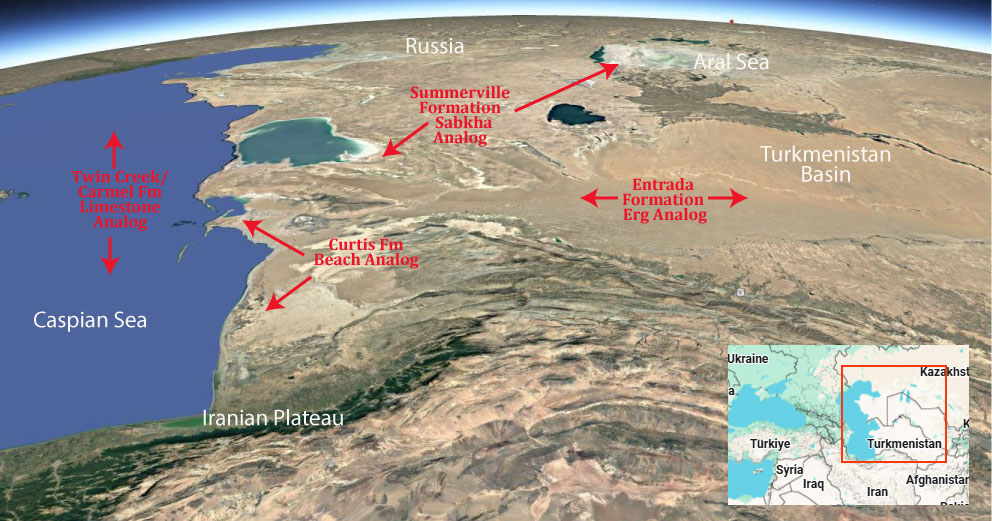
Modern Analog to Utah’s Middle Jurassic

Many modern analogs have been proposed for the desert ergs, sabkha’s and limestone’s of Utah’s Middle Jurassic, but we favor Africa & the Turkmenistan/Caspian Basin as it includes all the depositional environments found for this geologic period.

.

Paleogeography or Depiction of Utah during Middle Jurassic

What is the Grand Staircase?

The Grand Staircase is a unique and extensive exposure of Earth’s history, showcasing over 200 million years of sedimentary rock layers. Geologists often liken these layers to a “book,” allowing for a detailed study of the Earth’s past, including changes in climate and environment.

The major sedimentary rock units exposed in the Grand Canyon range in age from 200 million to 600 million years and were deposited in warm shallow seas and near-shore environments. The nearly 40 identified rock layers of Grand Canyon form one of the most studied geologic columns in the world.

[flickr_tags user_id=”95435349@N04″ randomize=”true” margins=”4″ pagination=”numbers” tags=”navajo” max_num_photos=”9″]

[flickr_tags user_id=”95435349@N04″ tags=”chinle, navajo”]

Moenkopi Formation (Geology of Utah’s Grand Staircase)

Explore unit thickness in All-in-One App

Grand Staircase Strat Column (Link).

Exposure:

The Moenkopi formation can be found throughout the Colorado Plateau. But its thickest extent stretches from southwest Utah to Northern Arizona.

Age:  Lower Triassic to possibly lower Middle Triassic

Depositional Environment: Tidal sabkha (also with nearshore shales, shallow marine limestones, and some floodplain)

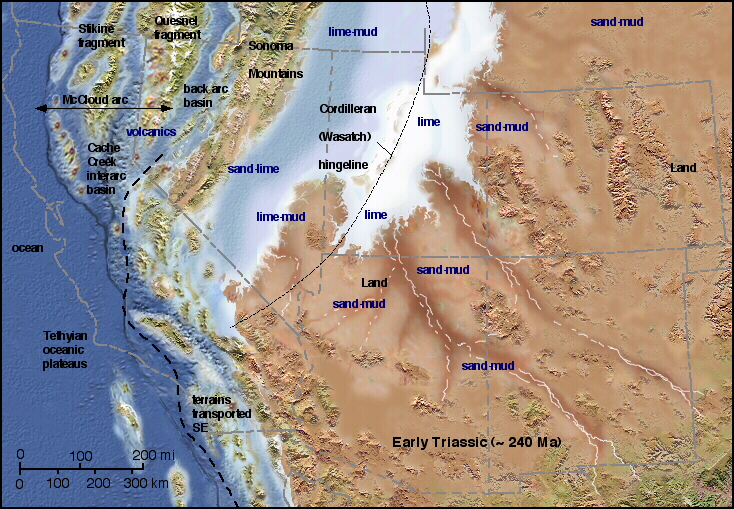
Paleogeography: The Moenkopi Formation was deposited along the western portion of the United States

Tectonics: There was very little tectonic activity was occurring during the time of deposition.

Climate: During the initial deposition of the Moenkopi Formation, the climate was rather hot and dry, then during the later members (the Sinbad Limestone through the Moody Canyon Members) the climate progressively got wetter, but it was likely still arid (Blakey, 1973).

Features: The Moenkopi Formation preserves extensive ancient tidal and nearshore deposits. Continental conditions were located to the east, and marine conditions to the west. Four different members of the Moenkopi were deposited in the Capitol Reef region. The lowest Black Dragon Member was deposited under marine conditions preserving a shallowing upwards sequence, capped by beach sands and fluvial (river) deposits. Cyclic alternation of supratidal (above the ocean level) to subtidal (below ocean the level) deposits resulted in interbedded (alternating) mud and sand beds throughout much of the Moenkopi (Blakey, 1973).

Following the Black Dragon Member, the Sinbad Limestone Member was deposited under shallow marine conditions before clastic sedimentation resumed in the overlying Torrey Member. The final member, The Moody Canyon Member, was deposited under widespread, uniform, low-energy marine conditions, producing a generally “structure-less” mudstone (Blakey, 1973).

The Moenkopi Formation typically contains abundant thinly bedded mudstones and sandstones (Figures 2 and 3) with a large variety of ripple marks (Figures 4 and 5), and some trace fossils (impressions from animals in the sediment) (Figures 6 and 7).  Secondary gypsum veins cut through this formation (Figure 8 and 9).

Fault view to the left of Chimney Rock. The Shinarump Member on the left side of the photograph is downdropped compared to the right side. The blue dotted line indicates the inferred location of a normal fault.  The footwall is the Moenkopi Formation overlain by the Shinarump (right of photo) and the hanging wall is the Shinarump overlain by the Wingate (left of photo).
Complex ripples from a sandstone bed.
Gypsum veins running throughout the upper Moenkopi Formation directly underlying a Pleistocene Terrace.
The paleogeographic setting (Dubiel, 1994) shows the general tectonic elements of the Western Interior of Pangea.

Description:

The Moenkopi consists of thinly bedded sandstone, mudstone, and shale, with some limestone in the Capitol Reef area. It has a characteristic deep red color and tends to form slopes and benches. The depositional environment varies from fluvial channel and floodplain deposits in the eastern exposures to tidal mudflats in the Cedar Mesa area to deltaic sandstones and shallow marine limestones at Capitol Reef. In eastern Nevada and northwestern Utah, it thickens dramatically, then transitions to the Woodside, Thaynes, and Mahogany formations.

The general deposition setting was sluggish rivers traversing a flat, featureless coastal plain to the sea. The low relief meant that the shoreline moved great distances with changes of sea level or even with the tides. Thickness varies from a feather edge against the Uncompahgre highlands to the east to over 600 metres (2,000 ft) in southwestern Utah. The thickness varies greatly in the Paradox Basin, where the Moenkopi is thin to nonexistent on the crests of salt anticlines and over 400 meters (1,300 feet) thick in the corresponding synclines.

The Moenkopi rests unconformably on Paleozoic beds and the Chinle Formation in turn rests unconformably on the Moenkopi. Both unconformities are locally angular unconformities. The lower unconformity corresponds to the regional Tr-1 unconformity and the upper to the regional Tr-3 unconformity. The Tr-1 unconformity represents a hiatus of at least 20 million years while Tr-2 represents a hiatus of about 10 million years.

Members differ considerably from east to west, in part because sandstone beds corresponding to marine transgressions are used to define members to the west but cannot be traced to the east.

Modern Analog to Utah’s Middle Jurassic

Many modern analogs have been proposed for the desert ergs, sabkha’s and limestone’s of Utah’s Middle Jurassic, but we favor Africa & the Turkmenistan/Caspian Basin as it includes all the depositional environments found for this geologic period.

.

Paleogeography or Depiction of Utah during Middle Jurassic

What is the Grand Staircase?

The Grand Staircase is a unique and extensive exposure of Earth’s history, showcasing over 200 million years of sedimentary rock layers. Geologists often liken these layers to a “book,” allowing for a detailed study of the Earth’s past, including changes in climate and environment.

The major sedimentary rock units exposed in the Grand Canyon range in age from 200 million to 600 million years and were deposited in warm shallow seas and near-shore environments. The nearly 40 identified rock layers of Grand Canyon form one of the most studied geologic columns in the world.

[flickr_tags user_id=”95435349@N04″ randomize=”true” margins=”4″ pagination=”numbers” tags=”navajo” max_num_photos=”9″]

[flickr_tags user_id=”95435349@N04″ tags=”chinle, navajo”]