
Grand Canyon’s Redwall Limestone (Geology of The Grand Staircase)
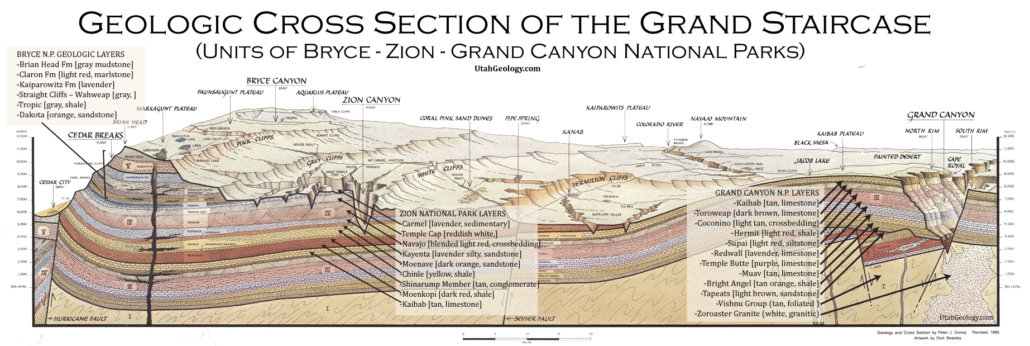
Explore unit thickness in All-in-One App

Exposure:
Prominent throughout the Grand Canyon (e.g., South Kaibab Trail); also visible in the Virgin River Gorge, Pavant Range, and San Rafael Swell.
Age: Mississippian, 359-330 million years ago.
Depositional Environment: High-energy shallow marine shelf. Specifically, a carbonate platform featuring oolitic shoals, crinoid thickets, and lime-mud flats distal from continental sediment sources.
Paleogeography: Located on the western passive margin of Laurentia. The region sat at approximately 10°–20° North latitude, effectively making it a tropical coastal shelf.
Tectonics: Characterized by a stable cratonic platform with slow subsidence. Distal to the developing Antler Orogeny (Cordilleran arc) to the west; largely undeformed until the Laramide.
Climate: Tropical to subtropical; warm, clear, and well-oxygenated waters promoted massive biological carbonate production and the growth of widespread coral and bryozoan colonies.
Features: Notable for its massive verticality and Thunder Springs Member, which contains distinctive alternating bands of gray limestone and dark, weather-resistant chert lenses.
Fossils: Extremely fossiliferous; dominated by crinoid columnals, spiriferid brachiopods, rugose (horn) corals, and bryozoans. Rare nautiloid “death beds” and fish teeth are also found


Description:
The Redwall Limestone is perhaps the most iconic architectural element of the Grand Canyon, forming a singular, vertical precipice that averages 500 to 800 feet in height. Despite its name and vibrant exterior, the formation is actually a light-gray, high-purity carbonate (~99% limestone and dolomite); its famous “red wall” is merely a superficial iron-oxide stain leached from the overlying Supai Group and Hermit Formation. Depositionally, the Redwall represents a massive marine transgression during the Mississippian Period (approx. 340 million years ago), when a warm, clear, epicontinental sea flooded the stable North American craton. This shallow-water shelf environment was largely free of terrigeneous (land-derived) sediment, allowing for the accumulation of thick successions of bioclastic lime muds and sands.
From a broader tectonic perspective, the Redwall Limestone was deposited along a passive margin on the western edge of the Laurentian continent, situated within the subtropics. This was a time of relative tectonic quiescence for the Southwest, preceding the dramatic crustal shortening of the later Paleozoic. To the west, the Cordilleran Miogeocline was beginning to transition into a more active setting as the Antler Orogeny initiated in present-day Nevada, yet the Colorado Plateau remained a stable, subsiding platform. The unit is divided into four distinct members—the Whitmore Wash, Thunder Springs, Mooney Falls, and Horseshoe Mesa—which record two major cycles of rising and falling sea levels (transgressions and regressions), resulting in a complex internal stratigraphy of massive limestone ledges and chert-rich layers.
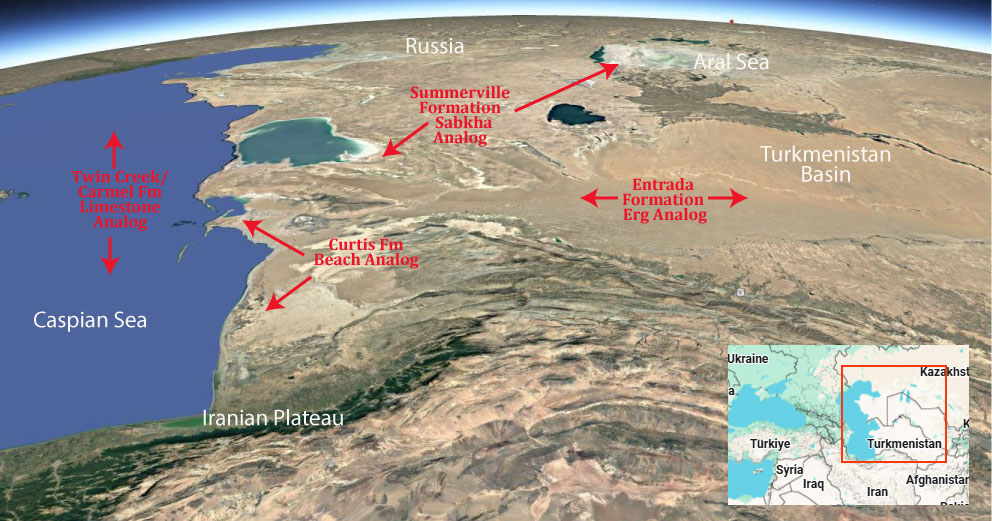
A modern analog for the Redwall’s depositional environment can be found in the Great Bahama Bank. Like the ancient Mississippian seaway, the Bahamas feature a broad, shallow carbonate platform where biological activity—rather than river-fed silt—drives sedimentation. In this clear, sunlit water, a diverse community of benthos thrived, including crinoids, brachiopods, and corals. Eventually, as the sea retreated at the end of the Mississippian, the exposed limestone surface underwent intense subaerial weathering. This led to a widespread paleokarst landscape characterized by sinkholes and caverns, many of which were later filled with the red mudstones of the Surprise Canyon Formation and Supai Group, creating a significant disconformity (a gap in the geologic record).
Modern Analog to Utah’s Middle Jurassic
.
Paleogeography or Depiction of Utah during Middle Jurassic

What is the Grand Staircase?
The Grand Staircase is a unique and extensive exposure of Earth’s history, showcasing over 200 million years of sedimentary rock layers. Geologists often liken these layers to a “book,” allowing for a detailed study of the Earth’s past, including changes in climate and environment.
The major sedimentary rock units exposed in the Grand Canyon range in age from 200 million to 600 million years and were deposited in warm shallow seas and near-shore environments. The nearly 40 identified rock layers of Grand Canyon form one of the most studied geologic columns in the world.

[flickr_tags user_id=”95435349@N04″ randomize=”true” margins=”4″ pagination=”numbers” tags=”navajo” max_num_photos=”9″]
[flickr_tags user_id=”95435349@N04″ tags=”chinle, navajo”]