
Tag Archive for: muav limestone

Grand Canyon’s Bright Angel Shale (Geology of The Grand Staircase)
Explore unit thickness in All-in-One App

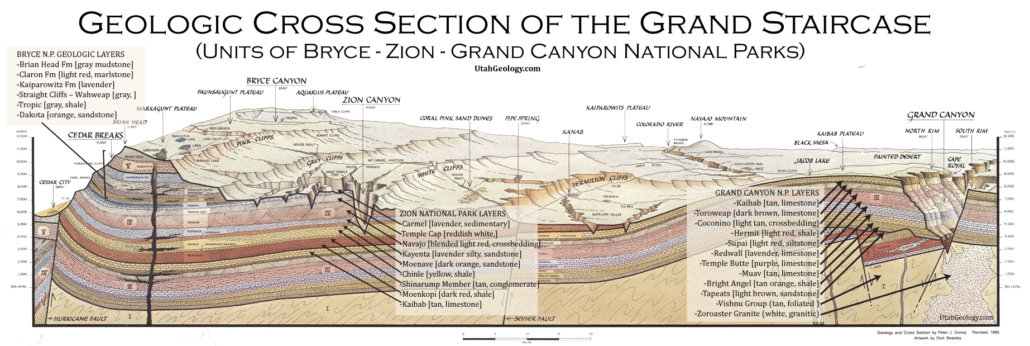
Grand Staircase Strat Column (Link).

Exposure: The unit is most famous for forming the wide, greenish “Tonto Platform” in the Grand Canyon, Arizona. It is best viewed along the Bright Angel Trail or the North Kaibab Trail, where it creates a distinct recessive slope between the cliff-forming Tapeats Sandstone below and the Muav Limestone above.

Age:  Middle Cambrian (approx. 505–515 Ma)

Lateral Equivalents: Pioche Shale (UT/NV), Langston Fm (Northern UT/ID), Wolsey Shale (WY/MT), Peerless Fm (CO), Carrara Fm (NV)

Depositional Environment: The environment was a distal, shallow marine shelf to subtidal mudflat. It sat below the constant agitation of the surf zone but was shallow enough to be affected by storm waves. The presence of glauconite suggests slow sedimentation rates in a relatively quiet, normal-salinity marine setting.

Paleogeography: The region was located on the western “trailing” passive margin of Laurentia. During the Middle Cambrian, the Southwest was positioned at equatorial latitudes, specifically within the tropical belt. The area consisted of a vast, flooded continental shelf with no significant terrestrial vegetation to hold back sediment.

Tectonics: Tectonically, this was a period of extreme stability following the Neoproterozoic rifting of Rodinia. The lack of mountain building (orogeny) allowed for a remarkably flat landscape, enabling the “Great Unconformity” to be draped by thousands of square miles of flat-lying, minimally deformed marine sediments as sea levels rose.

Climate: The climate was predominantly tropical to subtropical. With no land plants to regulate carbon dioxide or albedo, the Earth was in a “greenhouse” state. Warm, shallow seas covered much of the continent, promoting high calcium carbonate saturation and vibrant, though primitive, biological productivity in the water column.

Features: The unit is notable for its distinct slope-forming weathering pattern and “candy-striped” appearance caused by alternating layers of siltstone and shale. It frequently contains abundant mud-cracks, ripple marks, and green glauconite pellets, which give the shale its characteristic olive-drab to forest-green hue in many canyon exposures.

Fossils: The Bright Angel is a world-class source for Middle Cambrian trilobites, including Alokistocare and Glossopleura. It is also famous for its diverse trace fossils (ichnofossils), brachiopods, and primitive sponges, capturing the rapid diversification of body plans during the Cambrian Explosion within the muddy seafloor sediments.

View looking north from Tuweap area near Toroweap Point.

Description:

The Bright Angel Shale represents a pivotal chapter in the Paleozoic history of the American Southwest, serving as the middle member of the Tonto Group—a classic “transgressive sequence” that records the steady encroachment of the sea onto the North American craton. Formed approximately 505 to 515 million years ago during the Middle Cambrian, the unit consists primarily of fissile, greenish-gray micaceous shales, siltstones, and thin-bedded fine-grained sandstones. As the Sauk megasequence progressed, the high-energy beach environments of the underlying Tapeats Sandstone migrated eastward, giving way to the deeper, quieter waters of the Bright Angel. This depositional shift reflects a deepening marine shelf where fine-grained clastics could settle below the fair-weather wave base. In the modern world, geologists often look to the broad, shallow shelf of the Yellow Sea or parts of the northern Australian shelf as analogs, where sediment-starved epicontinental seas allow for the accumulation of extensive mudflats and subtidal silts.

Deposited along the passive margin of western Laurentia (the ancient core of North America), the Bright Angel Shale is a testament to the larger Cordilleran tectonic context. During this time, the supercontinent Rodinia had finished rifting apart, leaving behind a broad, flat coastal plain. The unit’s distinct “slope-forming” profile in the Grand Canyon is punctuated by intensive bioturbation, specifically the ichnofossil Skolithos and Cruziana—traces of ancient organisms churning through the mud. The geochemical environment was likely dysoxic to oxic, supporting a burgeoning community of marine life that benefited from the nutrient-rich runoff of the barren terrestrial landscape. Because the Cambrian sea transgressed from the west to the east over millions of years, the Bright Angel exhibits significant diachroneity; it is older in the western Grand Canyon and younger as it moves toward the cratonic interior, demonstrating how geologic units “climb” through time during a marine transgression.

On a regional scale, the Bright Angel Shale does not exist in isolation but is part of a massive, interconnected system of Cambrian marine deposits across the Rocky Mountain corridor. In northern Utah and southeastern Idaho, the unit is time-equivalent to the Pioche Shale and parts of the Langston Formation, which similarly record the transition from basal quartzites to trilobite-bearing mudstones. Further north and east into Wyoming and Montana, the Gros Ventre Formation and the Wolsey Shale represent the same sea-level rise, albeit with slight variations in sediment source and mineralogy. In Colorado, the Peerless Formation (often found above the Sawatch Quartzite) serves as the distal, younger equivalent. These units collectively define the “Cambrian Explosion” of life in the West, providing the primary substrate for some of the planet’s first complex reef-building organisms and diverse trilobite assemblages that flourished in the tropical, sun-drenched waters of the Cambrian shelf.

Modern Analog to Utah’s Middle Jurassic
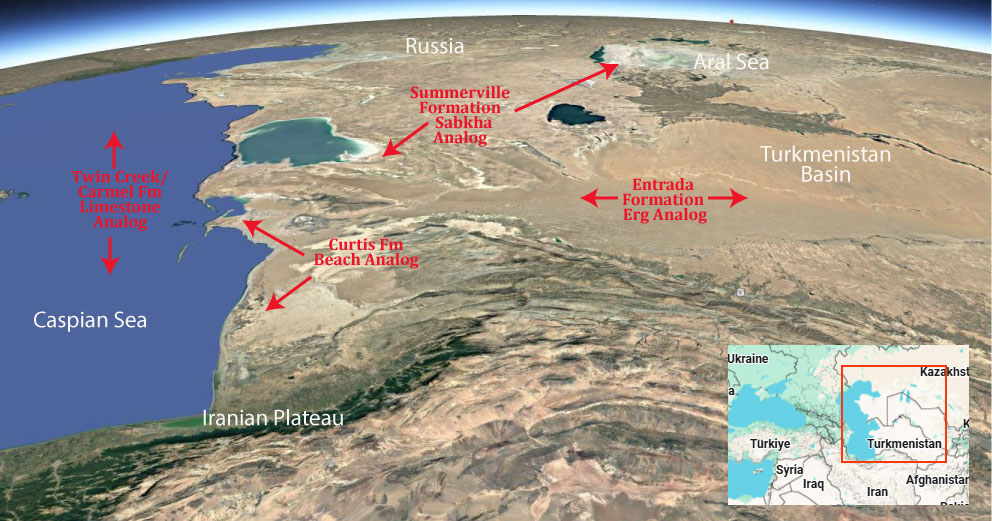
Trade this out with the Indus Delta!

.

Paleogeography or Depiction of Utah during Middle Jurassic

What is the Grand Staircase?

The Grand Staircase is a unique and extensive exposure of Earth’s history, showcasing over 200 million years of sedimentary rock layers. Geologists often liken these layers to a “book,” allowing for a detailed study of the Earth’s past, including changes in climate and environment.

The major sedimentary rock units exposed in the Grand Canyon range in age from 200 million to 600 million years and were deposited in warm shallow seas and near-shore environments. The nearly 40 identified rock layers of Grand Canyon form one of the most studied geologic columns in the world.

[flickr_tags user_id=”95435349@N04″ randomize=”true” margins=”4″ pagination=”numbers” tags=”navajo” max_num_photos=”9″]

[flickr_tags user_id=”95435349@N04″ tags=”chinle, navajo”]

Grand Canyon’s Tapeats Sandstone (Geology of The Grand Staircase)

Explore unit thickness in All-in-One App

Grand Staircase Strat Column (Link).

Exposure: The Tapeats is most spectacularly exposed in the Grand Canyon, Arizona, where it forms the dark, prominent cliff directly above the Inner Gorge. Excellent accessible views are found at the base of the Bright Angel Trail and along the Tonto Trail, where the unit creates a distinct “stair-step” in the canyon’s profile.

Age:  Early to Middle Cambrian (approx. 508–525 Ma)

Lateral Equivalents: Flathead Sandstone (WY/MT), Sawatch Quartzite (CO), Geertsen Canyon Quartzite (UT/ID), Tintic Quartzite (Central UT), Prospect Mountain Quartzite (NV)

Depositional Environment: The environment was a high-energy, tide-dominated nearshore and shoreface setting. It includes beach sands, intertidal flats, and shallow subtidal channels. The presence of large-scale cross-bedding and rounded quartz pebbles indicates powerful water currents and constant wave action that winnowed out finer silts, leaving behind mature, resistant sand.

Paleogeography:During deposition, the Southwest was located on the western passive margin of Laurentia at equatorial latitudes. The area was a vast, low-relief coastal plain transitioning into a broad epicontinental shelf. The lack of terrestrial vegetation meant the coastline was a stark landscape of sand dunes and rocky outcrops.

Tectonics: This period followed the successful rifting of Rodinia, occurring during a tectonically quiet phase. The region experienced thermal subsidence as the crust cooled, allowing the sea to transgress across the “Great Unconformity.” There was very little active deformation, resulting in the widespread, flat-lying nature of these basal sands.

Climate: The climate was tropical to subtropical, as North America straddled the equator. With high atmospheric CO2 levels, the Earth was in a greenhouse state. Intense chemical weathering on the barren continents provided the massive volume of quartz sand, while warm, shallow coastal waters facilitated high energy and sediment transport.

Features: The unit is notable for its resistant, cliff-forming nature and deep brown to reddish-tan coloration. It features spectacular primary sedimentary structures, including meter-scale tabular and trough cross-bedding, ripple marks, and “lag” deposits of well-rounded quartz pebbles at the contact with the underlying Precambrian Schist and Granite.

Fossils: The Tapeats is famous for its ichnofossils (trace fossils), particularly Skolithos—vertical, pipe-like burrows created by suspension-feeding organisms in the surf zone. While body fossils like trilobites are rare due to the high-energy environment, they are occasionally found in the upper, finer-grained transition zones leading into the Bright Angel Shale.

View looking north from Tuweap area near Toroweap Point.

Description:

The Tapeats Sandstone represents the dramatic onset of the Paleozoic Era across the American Southwest, serving as the basal member of the Tonto Group. Formed approximately 508 to 525 million years ago during the Early to Middle Cambrian, the Tapeats is the stratigraphic record of a massive marine transgression—the Sauk Transgression—where rising sea levels pushed the shoreline eastward across the barren crystalline basement of the North American craton. In the Grand Canyon, this unit is famous for draping over the “Great Unconformity,” a staggering erosional gap representing over a billion years of missing geologic time. The formation is primarily composed of cliff-forming, cross-bedded quartz sandstones and conglomerates, reflecting a high-energy depositional environment characterized by migrating sand waves and shoreface currents. Modern analogs can be found in the high-energy, tide-dominated sandy shorelines of the North Sea or the Bay of Fundy, where powerful currents redistribute coarse sediments across a broad, shallow shelf.

The deposition of the Tapeats occurred along the western passive margin of Laurentia, the ancient core of North America. Following the Neoproterozoic rifting of the supercontinent Rodinia, the continental edge subsided, allowing the ocean to spill onto a remarkably flat landscape known as a “peneplain.” Because there were no land plants to stabilize the soil, the terrestrial surface was a stark, rocky wasteland. Weathering produced vast quantities of quartz-rich sand that were transported by wind and ephemeral braided streams toward the encroaching coast. As the sea advanced, these sands were reworked into a complex mosaic of beach, shoreface, and tidal-channel deposits. This process was diachronous, meaning the Tapeats “climbed” in time; it is older in the west (Basin and Range) and becomes progressively younger as it moves toward the continental interior of Arizona and Utah, recording the slow, relentless landward march of the Cambrian tides.

Regionally, the Tapeats Sandstone is part of a vast “blanket sand” that covers much of the Western United States, though it bears different names in adjacent basins. In northern Utah and southeastern Idaho, this basal Cambrian quartzite is known as the Geertsen Canyon Quartzite or the Brigham Group, which similarly rests atop Precambrian basement rock. In Wyoming and Montana, the time-equivalent unit is the Flathead Sandstone, a prolific ridge-former in the Wind River and Bighorn mountains. To the east in Colorado, the Sawatch Quartzite represents the same transgressive event as the sea reached the Ancestral Rocky Mountain region. Collectively, these units represent the first pulse of the Sauk Megasequence, a global sea-level rise that fundamentally restructured the paleogeography of the Cordilleran margin and set the stage for the subsequent “Cambrian Explosion” of marine life.

Modern Analog to Utah’s Middle Jurassic

Trade this out with the Indus Delta!

.

Paleogeography or Depiction of Utah during Middle Jurassic

What is the Grand Staircase?

The Grand Staircase is a unique and extensive exposure of Earth’s history, showcasing over 200 million years of sedimentary rock layers. Geologists often liken these layers to a “book,” allowing for a detailed study of the Earth’s past, including changes in climate and environment.

The major sedimentary rock units exposed in the Grand Canyon range in age from 200 million to 600 million years and were deposited in warm shallow seas and near-shore environments. The nearly 40 identified rock layers of Grand Canyon form one of the most studied geologic columns in the world.

[flickr_tags user_id=”95435349@N04″ randomize=”true” margins=”4″ pagination=”numbers” tags=”navajo” max_num_photos=”9″]

[flickr_tags user_id=”95435349@N04″ tags=”chinle, navajo”]

Grand Canyon’s Muav Limestone (Geology of The Grand Staircase)

Explore unit thickness in All-in-One App

Grand Staircase Strat Column (Link).

Exposure: Best seen in the Grand Canyon as the top layer of the Tonto Platform (e.g., along the Bright Angel Trail). It also crops out in the Virgin River Gorge of Arizona/Utah and the Frenchman Mountain area near Las Vegas.

Age:  Middle Cambrian, 505-495 million years ago.

Depositional Environment: Primarily a shallow marine carbonate shelf. It transitioned between subtidal flats and deeper offshore “ramp” environments. The frequent silt partings suggest a fluctuating sea level where muddy terrestrial runoff occasionally mixed with the clear-water lime muds of the open shelf.

Paleogeography: Part of the western margin of Laurentia. The region was located near the equator, meaning the “Southwest” was actually a tropical, westward-facing coastline at the time. The vast, flat interior of the continent lay to the east, largely devoid of land plants.

Tectonics: Occurred during a passive margin phase. The crust was cooling and subsiding following the earlier breakup of the supercontinent Rodinia. There was very little tectonic deformation or volcanic activity, leading to the remarkably horizontal and consistent layering seen across the Colorado Plateau today.

Climate: Tropical to subtropical. Because Laurentia sat astride the equator, the waters were warm and conducive to carbonate chemistry. The lack of land vegetation meant that weathering on the continent was purely chemical and physical, leading to high mineral runoff into the warming Cambrian seas.

Features: Notable for its mottled, “edgewise” conglomerates and thin, silty interbeds. The limestone often weathers to a dull orange or buff color on the surface, but when freshly broken, it reveals a dark, fine-grained gray or green interior. It forms distinctive “stairstep” cliffs.

Fossils: Contains a variety of Middle Cambrian marine life, most notably trilobites (like Alokistocare), brachiopods, and hyoliths. However, the most pervasive “fossils” are ichnofossils—the preserved burrows and tracks of unknown worm-like creatures that created the formation’s signature mottled texture through bioturbation.

View looking north from Tuweap area near Toroweap Point.

Description:

The Muav Limestone represents the climactic, “deepest-water” chapter of the classic Tonto Group sequence, a geologic trilogy that records the Great Cambrian Transgression across the Southwest. While the underlying Tapeats Sandstone and Bright Angel Shale represent beach and muddy near-shore environments, the Muav signifies a time when the sea had moved far enough inland to allow for the deposition of carbonate muds. In the Grand Canyon and southern Utah, the Muav is a cliff-forming unit, though its ledges are often “stairstepped” or mottled compared to the sheer face of the much younger Redwall Limestone. It is primarily composed of calcareous (lime-rich) and dolomitic mudstones, characterized by a unique “mottled” appearance caused by ancient burrowing organisms that churned the seafloor before the sediment hardened—a process known as bioturbation.

Depositionally, the Muav formed on a vast, shallow marine shelf known as an epicontinental sea. During the Middle Cambrian (approx. 505 Ma), North America—then part of the paleocontinent Laurentia—was tilted and partially submerged. The Muav was deposited in the “middle shelf” zone, where the water was clear enough for carbonate precipitation but still close enough to the coast to receive occasional pulses of silt and clay. These pulses created the thin, micaceous partings that separate the thicker limestone beds. A modern analog for this environment would be the inner Sahul Shelf off the northern coast of Australia or parts of the Yucatán Platform, where broad, shallow carbonate ramps transition from muddy shorelines to clear-water limestone-producing factories.

In the broader Cordilleran context, the Muav Limestone is a testament to the “passive margin” phase of Western North America. During this period, there were no towering mountains to the west; instead, the continent thinned out into a wide, submerged plain. The Muav thickens significantly as you move westward toward the Cordilleran Miogeocline in Nevada, reflecting a seafloor that was gently sloping into deeper oceanic basins. This stable tectonic setting allowed for the accumulation of hundreds of feet of sediment without the interruption of volcanic activity or mountain building. However, the top of the Muav is marked by a dramatic unconformity; a massive gap in the geologic record exists between the Muav and the overlying Devonian rocks, where millions of years of history were eroded away before the next layer was laid down.

Modern Analog to Utah’s Middle Jurassic

Trade this out with the Indus Delta!

.

Paleogeography or Depiction of Utah during Middle Jurassic

What is the Grand Staircase?

The Grand Staircase is a unique and extensive exposure of Earth’s history, showcasing over 200 million years of sedimentary rock layers. Geologists often liken these layers to a “book,” allowing for a detailed study of the Earth’s past, including changes in climate and environment.

The major sedimentary rock units exposed in the Grand Canyon range in age from 200 million to 600 million years and were deposited in warm shallow seas and near-shore environments. The nearly 40 identified rock layers of Grand Canyon form one of the most studied geologic columns in the world.

[flickr_tags user_id=”95435349@N04″ randomize=”true” margins=”4″ pagination=”numbers” tags=”navajo” max_num_photos=”9″]

[flickr_tags user_id=”95435349@N04″ tags=”chinle, navajo”]