
Global Recent Earthquake Viewer
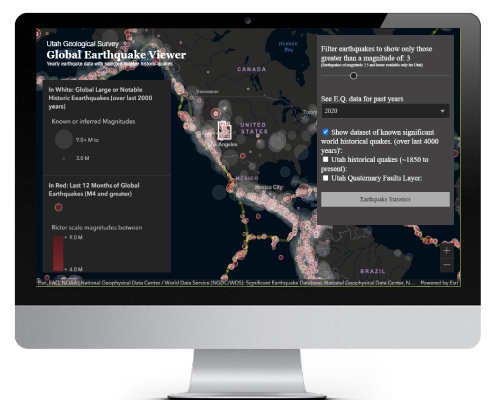
World Earthquake Explorer. Literally the worlds best earthquake viewer. Only at Utahgeology.com
(want to know if earthquakes are increasing in frequency or magnitude? Find it in the app.)
Find recent or historic earthquakes, lists, or information on selected significant earthquakes at the resources below. The University of Utah Seismograph Stations helps reduce the risk from earthquakes in Utah through research, education, and public service. The United States Geological Survey mission is to monitor, analyze, and predict current and evolving dynamics of complex human and natural Earth-system interactions and to deliver actionable intelligence at scales and timeframes relevant to decision makers.
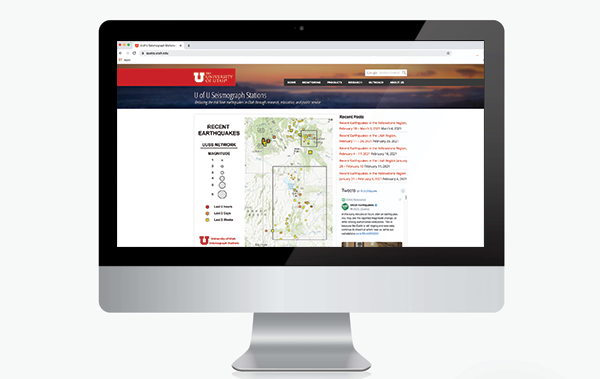
University of Utah Seismograph Stations earthquake viewer. Not nearly as cool as ours, but we’ll give them points for trying.

United States Geological Survey. Also not nearly as cool as ours, but useful non-the-less.
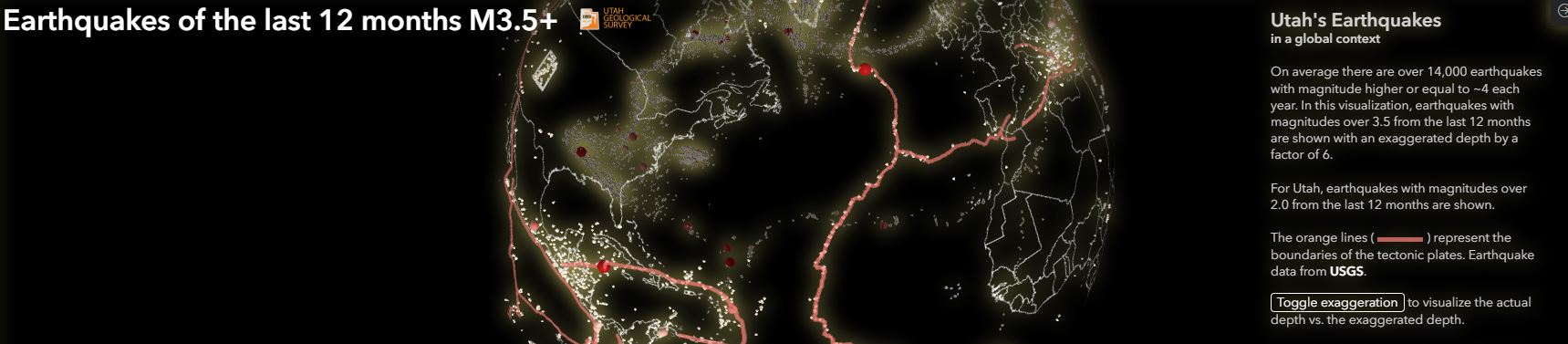
Historical Earthquakes
Studies of historical earthquakes provide a basic background for projecting future seismic hazards and losses.
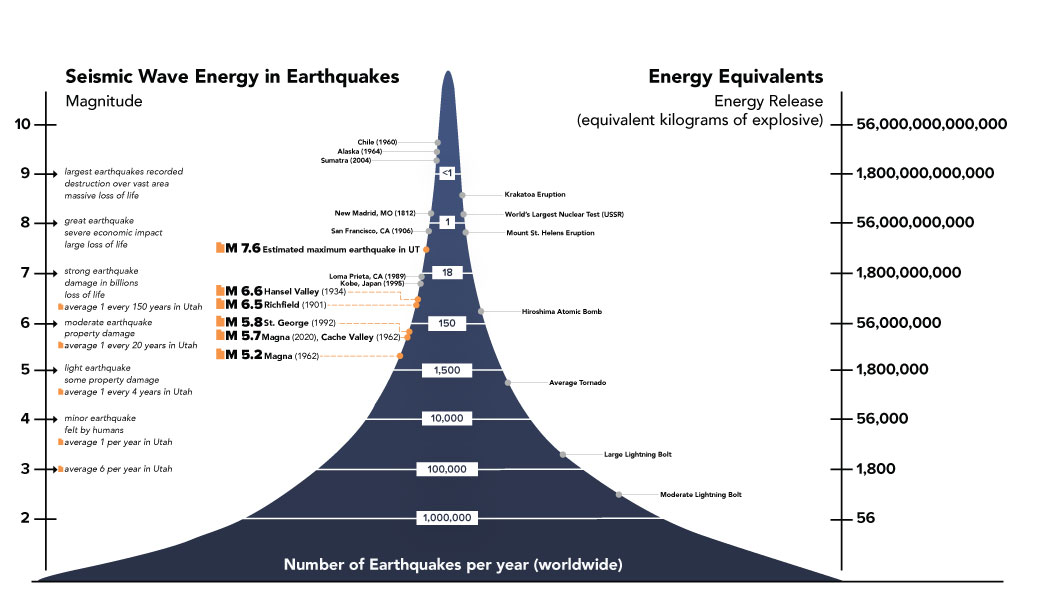
Magnitudes of historical earthquakes compared with energy release from other natural and man-made events. (Modified from Incorporated Research Institutes for Seismology, IRIS)
Utah has experienced 17 earthquakes greater than magnitude 5.5 since pioneer settlement in 1847, and geologic studies of Utah’s faults indicate a long history of repeated large earthquakes of magnitude 6.5 and greater prior to settlement. Utah is not on a boundary between tectonic plates where most of the world’s earthquakes occur, but rather is in the western part of the North American plate. However, earthquakes in Utah are related to interactions with the Pacific plate along the plate margin on the west coast of the United States.
There is a 57% probability that the Wasatch Front region will experience at least one magnitude 6.0 or greater earthquake and a 43% probability of at least one magnitude 6.75 or greater earthquake in the next 50 years.
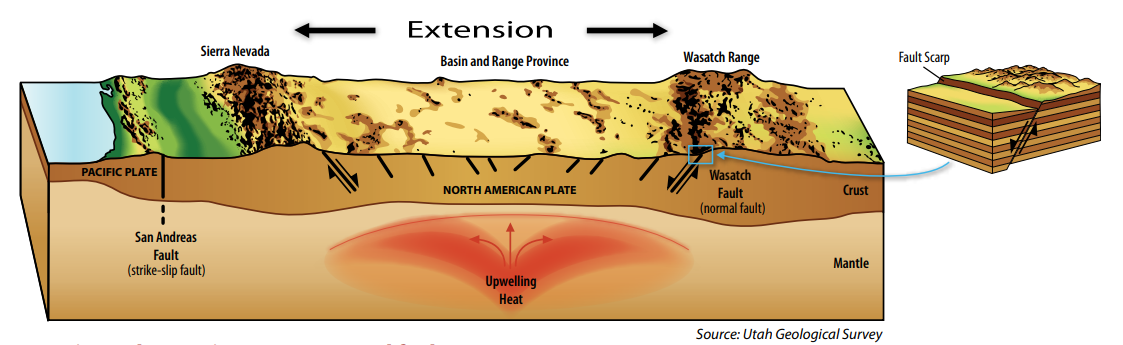
Stretching, or horizontal extension, of the crust produces a type of dipping (or inclined) fault called a “normal” fault. The movement of normal faults is characterized by the crust above the fault plane moving down relative to the crust below the fault plane. This up/down movement differs from movement on strike-slip faults like the San Andreas in California, where the crust on one side of the fault slides horizontally past the crust on the other side. Putting Down Roots in Earthquake Country
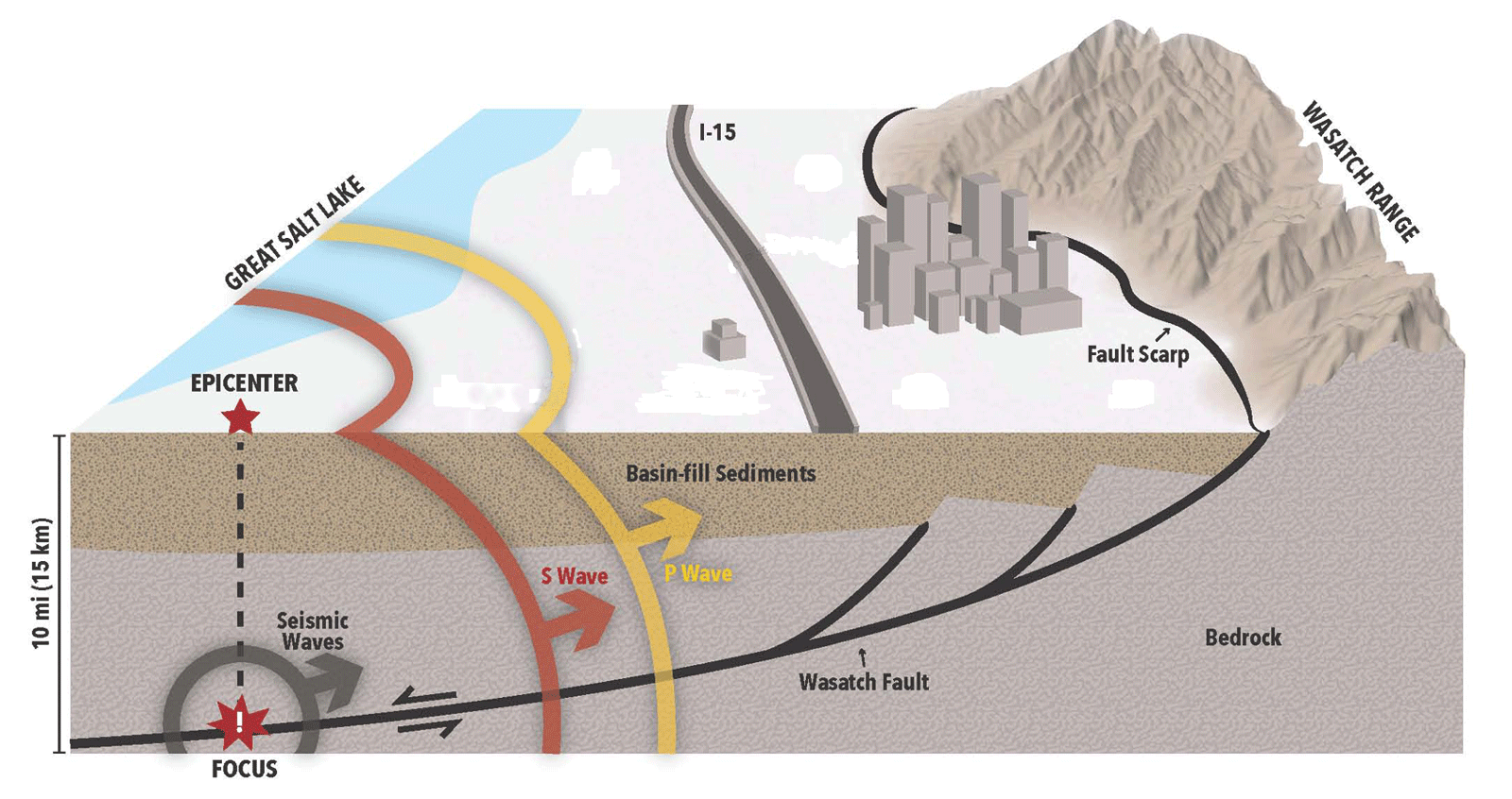
Generalized cross section showing a fault rupture which causes an earthquake and generates seismic waves. This is a conceptual diagram of how the Wasatch fault affects the Salt Lake Valley and does not show any specific seismic event.
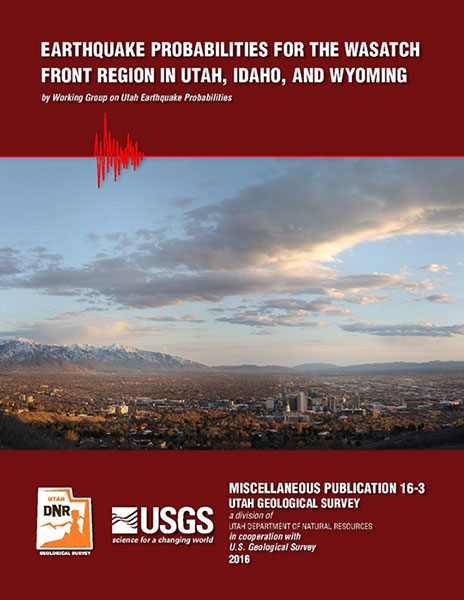
Earthquake Probabilities for the Wasatch Front Region
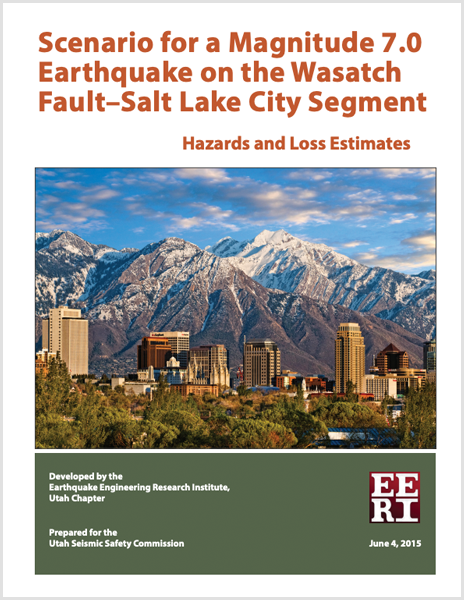
Scenario for a Magnitude 7.0 Earthquake on the Wasatch Fault
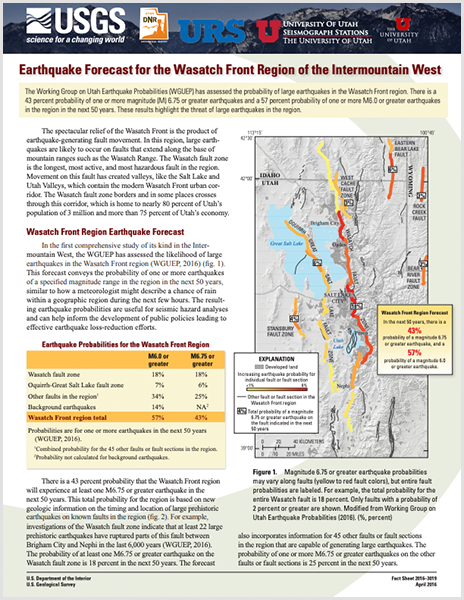
Earthquake Forecast for the Wasatch Front Region of the Intermountain West
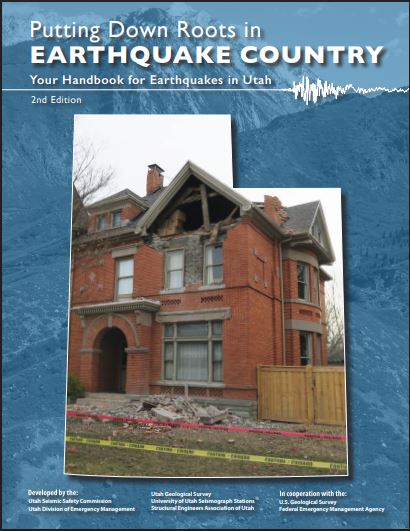
Putting Down Roots in Earthquake Country, 2nd Edition
Your Handbook for Earthquakes in Utah.